

How employers can reduce workplace anxiety is an important question in today’s working environment. Workplace anxiety is often discussed as an individual problem. Employees are encouraged to manage stress, become more resilient, organise their time and maintain a healthy work-life balance. While these strategies can help, they do not address an important part of the problem: the working environment itself.
Table of Contents
Imagine an employee who checks every email several times before sending it, hesitates to ask questions and feels uneasy whenever a manager calls them into a meeting. From the outside, this person may appear responsible and careful. Internally, however, they may be constantly worrying about making mistakes, facing criticism or failing to meet expectations.
Unrealistic deadlines, unclear responsibilities, excessive supervision and unpredictable decisions can contribute to such experiences. Even capable and experienced professionals may struggle when their working conditions repeatedly expose them to uncertainty and pressure.
Understanding workplace anxiety from the employee’s perspective also helps explain why organisational changes are necessary. The solution is not simply to introduce wellness programmes or encourage employees to think positively. It requires examining how work is organised, how managers behave and how people are treated.
Why Should Employers Take Workplace Anxiety Seriously?
Workplace anxiety does not always appear as an obvious mental health concern. It may show up as hesitation, difficulty concentrating, repeated checking, reduced confidence, irritability or reluctance to take responsibility.
An employee may continue completing assignments while privately worrying about making mistakes or disappointing a supervisor. Some may even avoid sharing ideas because they fear being judged.
The World Health Organization (WHO) identifies excessive workloads, low job control, inadequate support, unclear roles, bullying and discrimination among the psychosocial risks that can affect mental health at work.
Although workplace stress and anxiety are not identical, persistent work-related pressures can contribute to anxiety and other mental health difficulties.
Employers therefore need to look beyond individual reactions. They should also examine whether their workplace practices are creating avoidable psychological pressure.
How Employers Can Reduce Workplace Anxiety: 7 Practical Changes
Employers can reduce workplace anxiety by making thoughtful changes to how work is organised, how managers interact with employees and how people are treated. These changes do not require eliminating every workplace challenge. Instead, they focus on creating an environment where employees feel supported, respected and confident in their responsibilities. Here are seven practical ways organisations can make a meaningful difference.
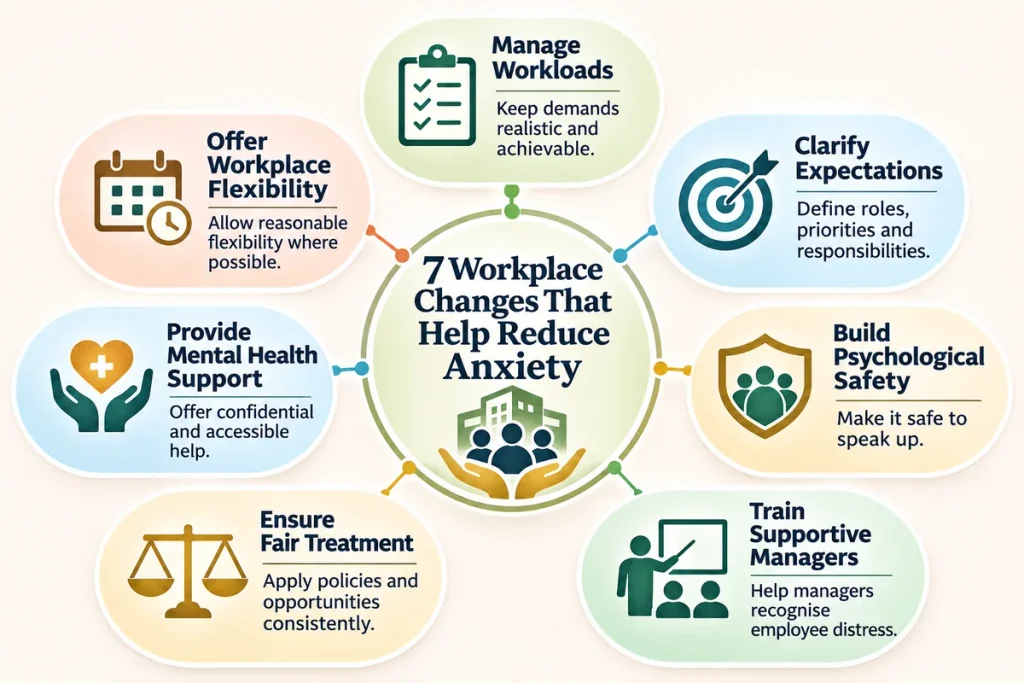
Make Workloads Realistic and Achievable
One important source of workplace pressure is the persistent feeling that there is more work than a person can reasonably complete.
When employees regularly face unrealistic deadlines, insufficient staffing or competing priorities, they may begin working in a constant state of urgency. Even after completing one assignment, another demand is waiting.
Employers should review workloads, available resources and expected completion times. Managers should distinguish between genuinely urgent work and tasks that can be scheduled differently.
What employers can do:
- Set deadlines according to actual workload and available resources.
- Review staffing and redistribute responsibilities when necessary.
- Avoid treating repeated overtime as a normal measure of commitment.
- Establish clear priorities when several tasks compete for attention.
The objective is not to remove professional challenges. It is to ensure that work demands remain manageable and proportionate to employees’ responsibilities and working hours.
Give Employees Clear Expectations and More Control
Uncertainty can make even ordinary responsibilities feel stressful.
When employees do not understand what is expected, who makes the final decision or which task deserves priority, they may spend considerable mental energy worrying about whether they are doing the right thing.
Role clarity helps reduce this uncertainty. Employers should communicate responsibilities, performance expectations and decision-making boundaries clearly. Where possible, employees should also have reasonable control over how they organise their work.
What employers can do:
- Provide clear job descriptions and measurable expectations.
- Communicate changes in responsibilities promptly.
- Allow reasonable flexibility in organising tasks.
- Avoid unnecessary interference in routine decisions.
A sense of control does not mean working without accountability. It means having enough autonomy to perform responsibilities with confidence rather than constantly waiting for approval.
Build Psychological Safety Within Teams
Psychological safety refers to an environment where employees feel comfortable asking questions, sharing ideas, admitting mistakes and expressing concerns without fear of humiliation or retaliation.
Consider an employee who notices an error but remains silent because previous mistakes were met with public criticism. The employee may decide that staying quiet is safer than speaking up.
This can affect both individual wellbeing and organisational performance. Problems remain unreported, useful ideas are withheld and employees become increasingly hesitant.
Research published by the American Psychological Association (APA) in its 2024 Work in America survey found that 43% of surveyed US workers typically felt tense or stressed during their workday. This figure was higher, at 61%, among those reporting lower psychological safety. These findings demonstrate an association, not proof that psychological safety alone determines stress levels.
What employers can do:
- Encourage employees to raise concerns without embarrassment.
- Respond constructively when someone makes an honest mistake.
- Invite different opinions during team discussions.
- Avoid public humiliation, intimidation and blame-based management.
Psychological safety does not mean eliminating accountability. It means maintaining professional standards without making people afraid to communicate.

Train Managers to Recognise Employee Distress
An employee’s daily experience of the workplace is often shaped by their relationship with their direct manager.
A manager who communicates aggressively, dismisses concerns or responds unpredictably can make an otherwise manageable job feel emotionally exhausting.
Managers therefore need more than technical and administrative skills. They also need the ability to recognise signs of distress and respond appropriately.
The WHO recommends mental health training for managers, including active listening, open communication and understanding how workplace stressors affect employees.
What employers can do:
- Train supervisors in supportive communication.
- Encourage regular, respectful one-to-one conversations.
- Help managers recognise behavioural changes that may indicate distress.
- Replace threatening or humiliating feedback with specific, constructive guidance.
Managers should not be expected to diagnose or treat mental health conditions. Their responsibility is to listen without judgement, respond sensitively and help employees access appropriate support.
Sometimes, a simple question such as “Is there anything making your work more difficult at the moment?” can open a conversation that an employee has been hesitant to begin.
Communicate Organisational Changes Transparently
Uncertainty about organisational decisions can become a significant source of workplace anxiety.
Changes in leadership, restructuring, new performance targets or revised responsibilities may leave employees wondering how their roles will be affected.
When reliable information is unavailable, people may begin interpreting silence, rumours and incomplete messages as signs of possible trouble.
Employers cannot always prevent uncertainty, but they can reduce unnecessary confusion.
What employers can do:
- Explain the reasons behind important organisational changes.
- Communicate what is known and what remains undecided.
- Provide regular updates rather than allowing rumours to fill information gaps.
- Give employees opportunities to ask questions and express concerns.
Honest communication does not require employers to promise outcomes they cannot guarantee. It requires them to communicate responsibly and acknowledge employees’ concerns.
Create a Fair and Respectful Working Environment
An employee’s sense of security can also be affected by how fairly they are treated.
Favouritism, discrimination, bullying and inconsistent treatment can make people question whether their contributions are valued or whether they will be treated fairly when problems arise.
For example, when employees believe that mistakes are judged differently depending on who makes them, they may become excessively cautious. They might avoid expressing opinions, taking initiative or asking for help.
Fairness is therefore not merely an administrative responsibility. It is an important part of creating a healthier organisational environment.
What employers can do:
- Apply workplace policies consistently.
- Address bullying, harassment and discriminatory behaviour.
- Provide accessible and impartial grievance procedures.
- Recognise contributions fairly and transparently.
- Treat employees with dignity regardless of their position.
A respectful workplace does not mean everyone will always agree. It means disagreements and differences are handled without intimidation or disrespect.
Provide Confidential Support and Reasonable Flexibility
Even a well-managed workplace cannot eliminate every source of anxiety. Some employees may experience mental health difficulties that require additional support.
Employers should make it easier for employees to seek help without fearing that doing so will damage their professional reputation.
Confidential counselling services, Employee Assistance Programmes (EAPs), access to qualified mental health professionals and appropriate workplace adjustments can help.
What employers can do:
- Provide access to confidential professional support.
- Respect employees’ privacy when they disclose mental health concerns.
- Consider flexible schedules or modified assignments where appropriate.
- Allow reasonable time for health-related appointments.
- Support employees returning after mental health-related absence.
The WHO recommends reasonable workplace accommodations, which may include flexible working hours, modified assignments, time for health appointments and supportive meetings with supervisors.
Importantly, counselling and wellness programmes should complement efforts to improve working conditions. They should never become substitutes for addressing avoidable workplace stressors.
How Can Employers Know Whether Changes Are Working?
Introducing workplace wellbeing policies is only the beginning. Employers also need to understand whether employees are experiencing genuine improvements.
A few practical measures can help:
- Conduct anonymous employee surveys about workload, management support and psychological safety.
- Hold regular team discussions about workplace challenges.
- Monitor patterns in absenteeism, staff turnover and repeated overtime.
- Review complaints relating to bullying, unfair treatment and excessive pressure.
- Assess whether employees feel comfortable raising concerns.
The Health and Safety Executive’s Management Standards provide a useful evidence-informed approach to assessing six areas associated with work-related stress: demands, control, support, relationships, role and organisational change.
Employers can use these areas as a starting point for reviewing their own working conditions.
Employee feedback should lead to visible action. Repeatedly asking people about workplace problems without addressing them may further weaken trust.

Final Thoughts: A Healthier Workplace Begins With Better Management
Reducing workplace anxiety does not mean removing every challenge or creating an environment where employees never experience pressure.
It means ensuring that ordinary professional responsibilities do not become unnecessary sources of persistent fear, uncertainty and emotional strain.
Employers can make a meaningful difference through realistic workloads, clear expectations, supportive managers, transparent communication, fair treatment and accessible mental health support.
Ultimately, reducing workplace anxiety requires more than teaching individuals to tolerate difficult working conditions. Employers must also examine the pressures created by their own organisational practices. How employers can reduce workplace anxiety is therefore not just a question of employee wellbeing, but also one of responsible leadership, fair management and healthier workplace culture.
A psychologically healthier workplace is not built through motivational messages alone. It develops through everyday management decisions that allow people to work with greater clarity, dignity, confidence and security.
Frequently Asked Questions (FAQs)
1. How can employers reduce workplace anxiety?
Employers can reduce workplace anxiety by creating realistic workloads, setting clear expectations, encouraging open communication, training supportive managers and ensuring fair treatment. Providing confidential mental health support and reasonable workplace flexibility can also help employees feel more secure.
2. What causes anxiety in the workplace?
Workplace anxiety can be associated with excessive workloads, unrealistic deadlines, unclear responsibilities, job insecurity, poor management, bullying and fear of criticism. A lack of control and inadequate support can further increase workplace pressure.
3. How can managers support employees experiencing workplace anxiety?
Managers can support employees by listening without judgement, communicating expectations clearly and responding sensitively to their concerns. They should avoid intimidating behaviour, recognise signs of distress and help employees access appropriate professional support when needed.
4. What is psychological safety in the workplace?
Psychological safety refers to an environment where employees feel comfortable expressing opinions, asking questions, sharing concerns and admitting mistakes without fear of humiliation or retaliation. It encourages trust, open communication and healthier working relationships.