

You have a few things to do. Reply to an important message, organise some documents, put away the laundry or make a phone call. None of them seems particularly complicated. Yet, you keep putting them off. You know they need to be done, but finding the energy to begin feels surprisingly difficult.
Sometimes, you pick up your phone instead. At other times, you move from one unfinished activity to another without making much progress. Even deciding which task to tackle first can feel exhausting.
What makes this experience frustrating is that you are not necessarily unwilling to do these things. You may genuinely want to finish them. You might even feel guilty about postponing them. Still, you find yourself struggling to take that first step.
If this sounds familiar, you may have wondered: Why do simple tasks feel so hard? Am I becoming lazy, losing motivation or simply failing to manage my time properly?
Not necessarily.
Table of Contents
Sometimes, the difficulty has less to do with the task itself and more to do with the mental and emotional processes involved in starting it. Stress, cognitive overload, perfectionistic thinking, anxiety and difficulties with executive functioning can all make ordinary activities feel unusually demanding.
The interesting part is that you may know exactly what needs to be done and still struggle to act on that knowledge.
Understanding why this happens matters. When you interpret every unfinished task as a personal failure, you may respond with more self-criticism and pressure. But when you understand what is getting in the way, you can approach the problem more realistically.
Why Do Simple Tasks Feel So Hard Sometimes?
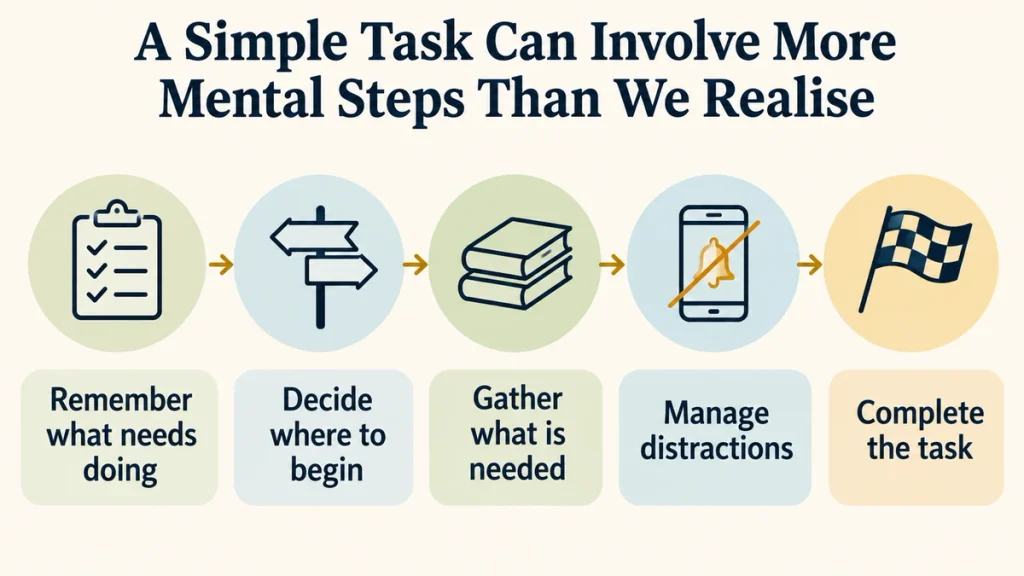
A task can be simple in terms of what it requires, yet demanding in terms of the mental processes involved in completing it.
Consider replying to an email. It may take only five minutes. But before writing the response, you might need to understand the message, recall relevant information, decide what to say and think about how the other person might react.
The activity looks simple from the outside. Mentally, however, it may involve several small decisions.
Our experience of effort also changes with our circumstances. A task that feels manageable when you are rested may seem exhausting after a demanding day, a stressful conversation or several hours of concentration.
Research on cognitive fatigue explores how sustained mental effort can influence the way people evaluate and approach further effort. A 2025 review by Pessiglione and colleagues discusses how cognitive fatigue may increase the perceived cost of cognitive control, making less effortful options more attractive. However, researchers are still investigating the mechanisms involved. This does not mean that every postponed task is caused by cognitive fatigue.
Knowing what to do and being able to start are different things
Have you ever known exactly what needs to be done but found yourself unable to begin?
For example, you need to prepare a report. You have the necessary information and understand the instructions. Yet, you keep checking messages, attending to smaller activities or thinking about the report without actually opening the document.
This happens partly because forming an intention and carrying it out involve different processes. You need to direct your attention, decide where to begin, organise the necessary steps and manage distractions.
These abilities are closely related to executive functioning. As psychologist Adele Diamond explains in her 2013 review in Annual Review of Psychology, executive functions include working memory, inhibitory control and cognitive flexibility. They help us organise behaviour, stay focused and adjust when circumstances change.
When these processes become difficult to manage, even familiar activities can feel surprisingly demanding.
Why this experience can affect anyone
Struggling with everyday tasks is not exclusive to people with ADHD or any particular psychological condition.
It can happen during periods of stress, poor sleep, emotional strain, excessive responsibilities or prolonged mental effort. For some people, however, persistent difficulties with planning, attention and task initiation may be associated with an underlying psychological or neurodevelopmental condition.
The important thing is not to jump to conclusions. Having a difficult day does not mean something is wrong with you. But when the same pattern repeatedly interferes with your work, personal responsibilities or relationships, it deserves attention rather than self-criticism.
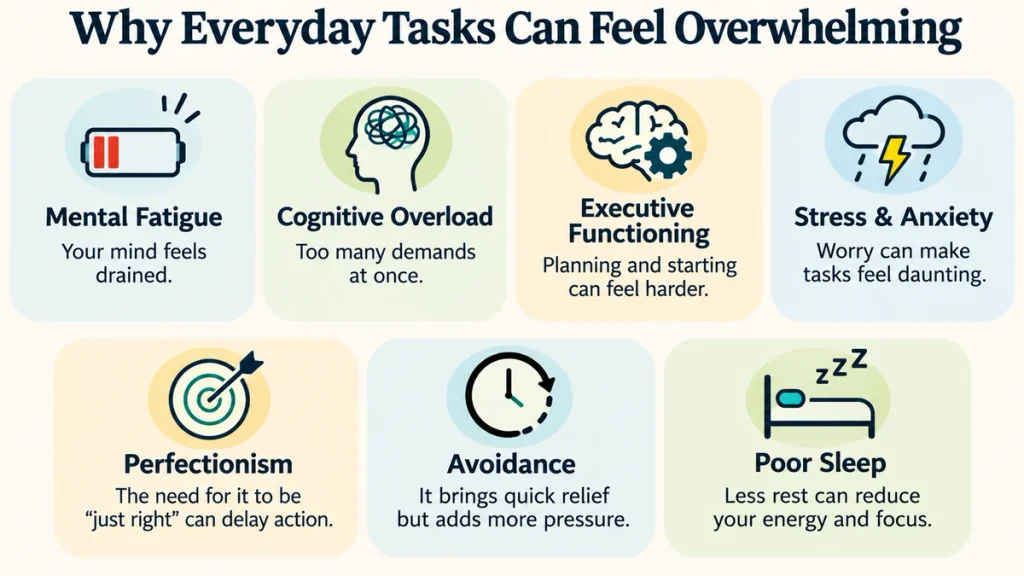
Seven Psychological Reasons Why Everyday Tasks Feel Overwhelming
There is rarely one explanation that applies to everyone. Two people may postpone the same activity for entirely different reasons. Understanding the possible contributors can help you recognise what might be happening in your own situation.
Mental fatigue makes additional effort feel costly
After a demanding day, even a familiar activity may require more effort than usual. You might have spent hours concentrating, making decisions, responding to people or managing unexpected responsibilities. By the time you sit down to complete another task, you may feel reluctant to engage in anything that requires further concentration.
This is related to cognitive fatigue, although mental tiredness and cognitive fatigue are not always used in exactly the same way in research. The 2025 review by Pessiglione and colleagues suggests that sustained cognitive effort may influence how people evaluate further effort. It does not establish that the brain simply runs out of energy or that every difficult task reflects a depleted mental resource.
You may notice this pattern when an activity feels manageable in the morning but becomes difficult later in the day. If persistent mental exhaustion is a bigger part of your experience, you may also find it helpful to read why you feel mentally exhausted. That article explores mental tiredness in greater detail.
Too many demands compete for your attention
Imagine trying to prepare a document while remembering an appointment, responding to messages and thinking about an unfinished household responsibility. Your attention is not devoted entirely to the document. Part of it is occupied by remembering, deciding and switching between different demands.
Working memory helps us hold and work with information for a short period. When several demands compete for attention, it can become harder to keep track of what you were doing and what needs to happen next.
The concept of cognitive load helps explain why complex information and competing demands can make concentration more difficult. Cognitive Load Theory was developed primarily in the context of learning, so applying it to everyday responsibilities should be understood as a useful explanatory perspective rather than a direct diagnosis of mental overload.
You may recognise this when you keep forgetting the next step, move between unfinished activities or feel unsure about which responsibility deserves attention first.
Executive functioning difficulties make getting started harder
Executive functioning refers to mental abilities that help us plan, organise, prioritise, remember instructions and regulate our behaviour. These abilities are involved in many ordinary activities, from preparing a meal to completing a work assignment.
A difficulty with executive functioning may look like knowing that you need to clean your room but not knowing where to begin. You may understand the task perfectly well but struggle to break it into steps, maintain attention or move from one stage to another.
Diamond’s review, Executive Functions (2013), describes working memory, inhibitory control and cognitive flexibility as core executive functions. These abilities work together, and their effectiveness can be influenced by factors such as stress and sleep.
Executive functioning difficulties can occur for different reasons. They are associated with ADHD, but they are not exclusive to it. Stress, poor sleep and other health concerns may also affect how well these processes work.
Stress and anxiety make ordinary responsibilities feel more demanding
Sometimes, the difficult part of a task is not what you have to do but what you think might happen when you do it.
You may postpone an email because you are worried about the response. You might avoid making a phone call because you fear an uncomfortable conversation. Even a routine responsibility can feel intimidating when you anticipate criticism, uncertainty or an unwanted outcome.
Stress can influence attention and executive functioning, although its effects vary according to the person and situation. A review by Plieger and Reuter (2020) highlights that the relationship between stress and executive functioning is influenced by several moderating factors. It is therefore too simplistic to assume that stress always affects everyone in the same way.
If you notice that worry, fear of mistakes or repeated anticipation is making ordinary activities difficult, the emotional demands surrounding the task may deserve as much attention as the task itself.
Perfectionism turns small tasks into demanding projects
You may intend to write a simple email, but instead spend considerable time thinking about the perfect wording. Perhaps you want to organise your documents properly, so you keep postponing the activity until you have enough time to do it perfectly.
This is one way perfectionistic concerns can contribute to delay. When you are afraid of making mistakes or falling short of your own expectations, beginning may feel uncomfortable. You may prefer to wait until you feel completely prepared.
Research supports an association between certain dimensions of perfectionism and procrastination. A 2017 meta-analysis by Sirois, Molnar and Hirsch found a positive association between procrastination and perfectionistic concerns. This does not mean that every perfectionist procrastinates or that having high standards is inherently harmful.
A useful question is whether your standards are helping you do the task well or making it increasingly difficult to begin.
Avoidance provides temporary relief but increases future pressure
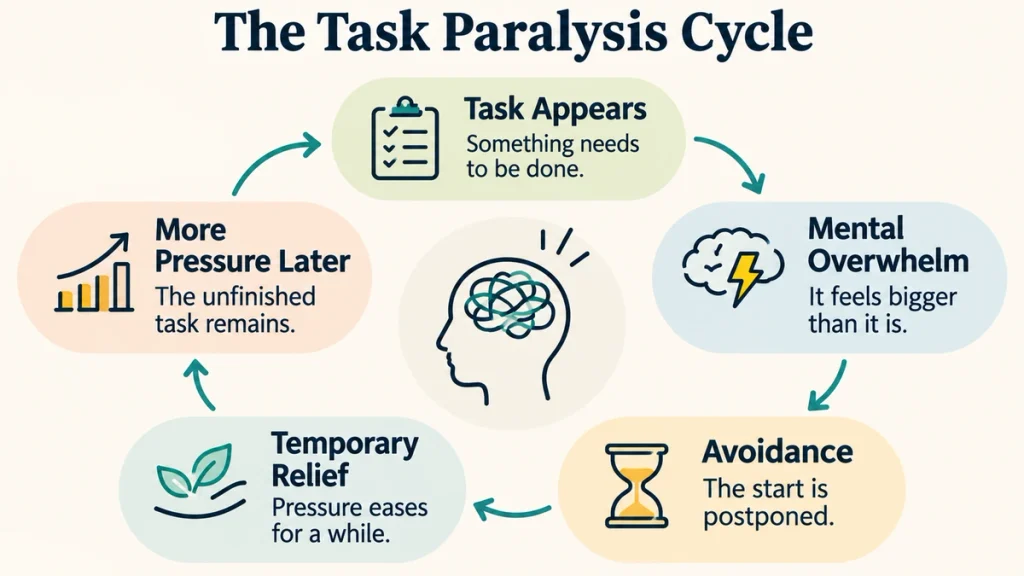
When a task makes you uncomfortable, postponing it may bring immediate relief. You do not have to make the difficult phone call, write the uncertain email or face the responsibility right now.
That relief can make avoidance more likely the next time a similar situation occurs. In behavioural psychology, this can be understood through negative reinforcement: a behaviour becomes more likely when it reduces or removes an unpleasant experience.
The problem is that the original responsibility usually remains. You may then experience guilt, worry or pressure because the task is still unfinished. As the delay grows, returning to it may feel even more uncomfortable.
This creates a cycle in which avoiding a task reduces discomfort temporarily but makes it harder to approach later. Recognising this pattern can help you respond before postponement becomes a recurring source of stress.
Poor sleep and physical health can reduce your capacity to cope
Sometimes, the reason everyday tasks feel difficult is not primarily psychological. Your body may not be recovering adequately, or an underlying health concern may be affecting your energy and concentration.
Sleep loss can affect working memory, attention and other executive functions. A 2025 meta-analysis by Cao and colleagues, published in Sleep Medicine Reviews, examined 79 publications and found that sleep loss was associated with impairments across several core executive-function measures.
Persistent tiredness can also have physical causes. The NHS identifies possible contributors such as sleep disorders, iron-deficiency anaemia, diabetes, thyroid problems, stress and depression. If fatigue continues for several weeks, affects daily life or occurs with other concerning symptoms, medical assessment is advisable.
It is worth remembering that not every difficulty should be approached as a productivity problem. Sometimes, understanding what your mind and body need is more important than trying another time-management technique.
What Is Task Paralysis? Why You Know What to Do but Cannot Start
You have a task in front of you. You know it needs attention, and you may even have enough time to complete it. Yet, you feel mentally stuck. You think about starting, move between other activities or keep postponing the first step.
This experience is commonly described as task paralysis. It is an informal term used to describe feeling unable to initiate or move forward with a task, despite recognising that it needs to be done.
Task paralysis is not a standalone psychiatric diagnosis. It is a descriptive way of talking about an experience that may arise in different circumstances, including stress, anxiety, cognitive fatigue and executive functioning difficulties.
Is task paralysis the same as procrastination?
The two experiences can overlap, but they are not identical.
Procrastination generally refers to delaying an intended activity despite expecting that the delay may have negative consequences. Task paralysis places more emphasis on the feeling of being stuck or unable to decide how to begin.
For example, you may postpone preparing a report because you are worried about making a mistake. That delay may be procrastination associated with perfectionistic concerns. Alternatively, you may feel unable to begin because you cannot organise the steps or decide what to do first.
In real life, these experiences can occur together. The useful question is not simply whether you are procrastinating, but what makes starting difficult in the first place.
How can you move from intention to action?
One useful approach is to make a specific plan about when and how you will begin. This is related to a psychological strategy called an implementation intention.
Instead of telling yourself, “I will organise my documents tomorrow,” make the plan more concrete: “After breakfast, I will spend ten minutes sorting the documents on my table.”
A meta-analysis by Gollwitzer and Sheeran (2006), covering 94 independent tests, found that implementation intentions can support goal achievement. These plans help connect a specific situation with an intended action. They do not solve every difficulty, but they can make the first step clearer.
Is It Mental Fatigue, ADHD, Anxiety or Something Else?
When everyday tasks repeatedly feel difficult, it is natural to wonder whether something more significant is happening. You may question whether you are mentally exhausted, experiencing anxiety or showing signs of ADHD.
The difficulty is that similar behaviours can have different explanations. Struggling to concentrate, organise responsibilities or begin activities does not, by itself, establish a diagnosis.
The broader pattern matters: how long the difficulty has been present, whether it occurs in different settings, what other symptoms accompany it and how much it affects everyday functioning.
When ADHD may be worth exploring
ADHD is a neurodevelopmental condition that begins during childhood and can continue into adulthood. Adults with ADHD may experience difficulties managing attention, staying organised, completing lengthy activities and following through on responsibilities.
These difficulties may become more noticeable when adult responsibilities increase. However, finding it difficult to start tasks is not enough to conclude that you have ADHD.
The CDC’s guidance on ADHD in adults explains that assessment considers symptoms and their history, including whether difficulties were present during childhood. A healthcare professional also considers other possible explanations, such as anxiety, depression and sleep problems.
When anxiety or depression may be contributing
Anxiety can make everyday activities feel difficult when you are preoccupied with possible mistakes, negative outcomes or uncertainty. You may spend so much time anticipating what could happen that the task itself becomes harder to approach.
The World Health Organization identifies difficulty concentrating, indecisiveness, restlessness and sleep problems among possible symptoms of anxiety disorders. These symptoms need to be considered in the context of the person’s overall experience and not used as a self-diagnosis checklist.
Depression can also affect everyday functioning. Persistent low mood, reduced interest, low energy, difficulty concentrating and indecisiveness may make ordinary responsibilities feel unusually demanding. The WHO’s information on depression explains how these symptoms can affect daily activities and when professional care may be needed.
Could sleep or physical health be involved?
If you feel unusually tired even after reducing your responsibilities, consider whether sleep or physical health may be contributing.
Poor-quality sleep, sleep disorders, medication effects and certain medical conditions can affect energy and concentration. Sometimes, the change is gradual, making it difficult to recognise how much your daily functioning has been affected.
The NHS guidance on tiredness and fatigue explains possible causes and when to consult a doctor. If your tiredness is persistent, unexplained or interfering with daily life, it is worth getting it assessed rather than assuming that you simply need more discipline.
Why Do Simple Tasks Feel Even Harder at Work?
Have you ever finished a full day at work but still felt that you had accomplished very little?
You may have answered emails, attended meetings, responded to colleagues and handled unexpected requests. Yet, an important report remains unfinished, a pending task has not been started and your mind feels unusually tired.
This can happen because being busy and making meaningful progress are not always the same thing. Workplaces often require us to manage several responsibilities, respond to interruptions and shift attention between activities.
Frequent task transitions can have cognitive and emotional consequences. A 2020 review by Leroy, Schmidt and Madjar in Academy of Management Annals examined how interruptions and task transitions influence attention, goal pursuit and work performance.
For example, you may be preparing a document when a phone call comes in. Shortly afterwards, someone asks you a question, and then another message appears. Returning to the original activity may require you to remember where you stopped and what you intended to do next.
Work pressure can add another layer. If you are worried about deadlines, scrutiny or making mistakes, even familiar responsibilities may feel more demanding.
If you regularly struggle with ordinary work responsibilities, consider whether the difficulty comes from the tasks themselves, the way work is organised or the mental and emotional demands surrounding them. Sometimes, the working environment needs attention too.
Work-related pressure does not always end when the working day is over. Sometimes, the mind continues to revisit unfinished tasks, pending responsibilities and conversations long after leaving the workplace. This difficulty switching off after work can make it harder to mentally recover, leaving less energy for even simple everyday responsibilities the next day.
How to Make Simple Tasks Feel Easier Again
Understanding why simple tasks feel difficult is important, but understanding alone may not change the experience. You still have responsibilities to manage, decisions to make and activities waiting to be completed.
The aim is not to force yourself to become productive every moment of the day. It is to reduce the barriers that make ordinary activities feel unnecessarily demanding.
Make the first step smaller
When a task feels overwhelming, you may be looking at the entire responsibility rather than the first action required to begin.
For example, thinking about cleaning the entire house can make the activity seem exhausting. But deciding to clear just one small area gives you a more manageable starting point.
Instead of telling yourself that you must organise all your documents, begin by sorting one folder. If you need to prepare a report, open the document and review the instructions. The purpose is not to avoid the larger responsibility. It is to make the first step less intimidating.
Reduce decisions and make the next action clear
Sometimes, you lose more energy deciding what to do than actually doing it. When several responsibilities compete for your attention, repeatedly reconsidering your priorities can make starting even harder.
Try identifying one important task in advance. Write down the first action required and keep any necessary materials ready. A short, realistic list of priorities is often more useful than a long list of everything you have not completed.
Vague tasks can also be difficult to approach. Instead of writing “prepare for the meeting,” list the actual actions: open the agenda, identify the documents required and review the relevant information. Each action gives your attention something concrete to work on.
Use short periods of focused work
When you are already mentally tired, committing to an hour of uninterrupted work may feel discouraging. You can instead begin with a shorter period that feels manageable.
Decide to spend ten minutes working on a particular task. After that, pause and consider whether you can continue or need a break. The purpose is to create an achievable opportunity to engage with the activity, not to meet an arbitrary productivity target.
You may find that starting reduces some of the resistance you felt beforehand. If it does not, you can still acknowledge the effort and reconsider what is making the task difficult.
Reduce distractions and unnecessary task switching
If you repeatedly move between messages, notifications and unfinished activities, maintaining attention can become harder.
Try keeping your phone away during a short period of focused work, closing unrelated browser tabs and keeping only the materials you need within reach. When you must switch activities, leave yourself a brief note about where you stopped.
The objective is not to eliminate every interruption. It is to reduce avoidable demands on your attention and make it easier to return to the task.
Replace self-criticism with a more supportive response
When you repeatedly postpone responsibilities, it is easy to become frustrated with yourself. You might think, “Why can’t I do something so simple?” or “I never get anything done properly.”
Repeated self-criticism may add emotional pressure without helping you identify the actual difficulty. Try asking yourself whether you are mentally exhausted, whether the task is unclear or whether you are worried about making a mistake.
This shift is consistent with the principles of self-compassion: recognising difficulty without responding to yourself with unnecessary judgement. Self-compassion does not mean avoiding responsibility. It means approaching problems with greater understanding and less self-criticism.
Address the underlying reason
Perhaps the most important step is recognising that the same behaviour can have different causes.
If you are mentally exhausted, you may need adequate rest and recovery. If you are anxious about a responsibility, understanding and addressing the underlying worry may help more than another to-do list. If you struggle with planning and organisation, external reminders and structured routines may be useful.
If persistent low mood, sleep problems or attention difficulties are interfering with everyday functioning, professional assessment may be more appropriate than repeatedly trying productivity techniques.
The solution should match the difficulty. Sometimes, making a task smaller is enough. At other times, the task is only one part of a larger problem that deserves attention.
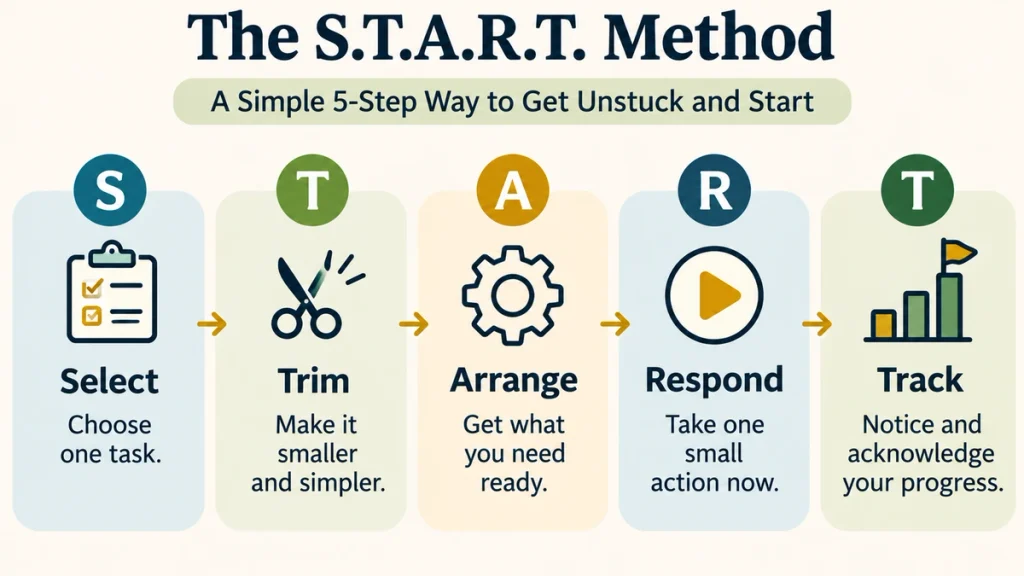
The S.T.A.R.T. Method: A Simple Way to Get Moving
Sometimes, you understand why you are struggling but still feel stuck when you look at the unfinished task. A simple structure can help you move from thinking about an activity to taking the first step.
For this article, let’s use an easy-to-remember approach: the S.T.A.R.T. Method. It is an original practical framework that brings together useful principles such as task breakdown, action planning and self-monitoring. It is not a clinically validated psychological treatment.
S – Select one task. Choose one activity that needs your attention. Avoid trying to solve everything at once.
T – Trim it down. Reduce the task to the smallest meaningful action. Instead of completing a report, begin by opening the document and reviewing the instructions.
A – Arrange what you need. Prepare the materials, information or space required to begin. Remove one or two distractions if possible.
R – Respond with a small action. Start with a manageable period of effort, perhaps five or ten minutes. You do not have to finish everything immediately.
T – Track your progress. Notice what you have completed. Decide whether to continue, take a break or identify the next small step.
Imagine that you have been postponing an important email for several days. Instead of repeatedly reminding yourself that you must reply, choose that one email, identify the main point, prepare the relevant information and write a rough response. You can then review it and decide whether it is ready to send.
Notice the difference. You are no longer trying to complete an undefined responsibility in one mental effort. You are moving through a sequence of clear actions.
The method will not make every difficult task easy. If you are exhausted, distressed or experiencing persistent difficulties with everyday functioning, you may need rest, support or professional guidance. Its purpose is simpler: to help you find a manageable starting point when the whole task feels too big.
When Should You Seek Professional Help?
Everyone has days when ordinary responsibilities feel difficult. You may struggle to concentrate after a demanding week, postpone household activities when you are tired or find it harder to make decisions during a stressful period.
These experiences do not automatically indicate a psychological problem. However, there is a difference between occasionally struggling with everyday tasks and repeatedly finding it difficult to manage ordinary responsibilities.
Consider speaking with a qualified mental-health professional or healthcare provider if the difficulty continues, becomes more intense or begins affecting several areas of your life.
This is particularly important if work, household responsibilities, personal care or relationships are becoming difficult to manage. Persistent changes in mood, sleep, energy or concentration also deserve attention.
Similar difficulties can occur with anxiety, depression, ADHD, sleep disorders, prolonged stress and certain physical health conditions. A professional can help explore the possible causes rather than assuming that every difficulty is a motivation or time-management problem.
If you are experiencing thoughts of self-harm or suicide, seek immediate support through local emergency services or a recognised crisis-support service. In India, you can call 112 for emergency assistance or Tele-MANAS at 14416 for mental-health support.
Seeking help does not mean you have failed to manage your responsibilities. It means you are taking persistent difficulties seriously and trying to understand what is behind them.
Frequently Asked Questions About Why Simple Tasks Feel So Hard
Why do simple tasks feel so overwhelming?
Simple tasks can feel overwhelming when the mental effort involved in starting, organising or completing them exceeds your available capacity at that moment. Stress, mental fatigue, too many competing responsibilities, anxiety and difficulties with executive functioning can all contribute.
Sometimes, the task itself is straightforward, but the decisions and emotions surrounding it make it feel much harder.
Why am I struggling with simple tasks even when I have enough time?
Having enough time does not necessarily mean you have the mental energy or clarity needed to begin. You may know that you have several hours available but still struggle to decide where to start, organise the steps or maintain your attention.
The difficulty may be less about time management and more about task initiation and mental effort.
What is task paralysis, and is it the same as procrastination?
Task paralysis describes the experience of feeling mentally stuck when you need to begin an activity, even though you know what needs to be done. Procrastination refers to unnecessarily delaying an intended activity, often despite expecting negative consequences.
The two experiences can overlap, but task paralysis is a descriptive term rather than a separate psychiatric diagnosis.
Can ADHD make simple everyday tasks feel difficult?
Yes. People with ADHD may experience difficulties with executive functioning, including organising activities, managing attention, remembering instructions and getting started on tasks.
However, struggling with simple tasks does not automatically mean you have ADHD. A proper assessment considers developmental history, symptoms across different settings and their impact on everyday functioning.
Can anxiety or depression make everyday tasks difficult?
Yes. Anxiety can make ordinary responsibilities feel more demanding when you are preoccupied with possible mistakes, negative outcomes or uncertainty.
Depression can affect everyday functioning through low energy, reduced interest, difficulty concentrating and problems making decisions. If these difficulties persist or interfere with daily life, consider speaking with a qualified professional.
How can I make myself start a task when I feel mentally stuck?
Rather than trying to force yourself to complete the entire activity, identify one small action that you can take immediately. If you have been postponing a report, begin by opening the document and reading the instructions.
Reducing the size of the first step, preparing what you need and limiting distractions can make starting more manageable. If the difficulty keeps returning, try to understand the underlying reason instead of assuming that you simply lack discipline.
A Final Thought: Understand What Is Getting in the Way
There are times when even the smallest responsibilities feel surprisingly difficult. You may postpone a phone call, avoid opening an email or struggle to complete something that would normally take only a few minutes.
It is easy to interpret these moments as laziness, poor discipline or a lack of motivation. But the reasons may be more complicated. Mental fatigue, cognitive overload, stress, anxiety, perfectionism and difficulties with executive functioning can all influence how easily you begin and complete everyday activities.
Understanding these factors does not mean avoiding responsibility. It means recognising that struggling with a task is not always a matter of unwillingness.
Sometimes, you need to make the first step smaller. Sometimes, you need to reduce distractions, organise your priorities or give yourself time to recover. And sometimes, persistent difficulties deserve professional attention.
So, the next time a simple task feels unusually difficult, pause before judging yourself. Instead of asking, “Why can’t I do something so simple?”, try asking, “What is making this difficult for me right now?”
You do not have to make everything easier in one day. Sometimes, you only need to make the next step possible.
Editorial note: This article is intended for psychological education and general well-being awareness. It does not diagnose mental-health conditions or replace medical assessment, counselling or other professional care. If persistent difficulties are affecting your daily life, consider seeking guidance from a qualified healthcare professional.