

Why do I get frustrated easily and cry, even when I am not feeling particularly sad? Perhaps you have asked yourself this question after a difficult conversation, a small mistake, or a day when one more problem felt like too much to handle.
You may feel angry because something is not working out, yet find yourself fighting back tears instead of expressing your frustration. Afterwards, you might feel embarrassed or wonder why you reacted so strongly.
The experience can be confusing, but frustration and crying are not mutually exclusive. Frustration can coexist with helplessness, disappointment, emotional overload, or the feeling that nobody understands what you are trying to express.
Understanding why frustration sometimes leads to tears can help you recognise what is happening beneath the immediate reaction and respond to yourself with greater compassion.
Table of Contents
Why Do I Get Frustrated Easily and Cry? Understanding the Connection
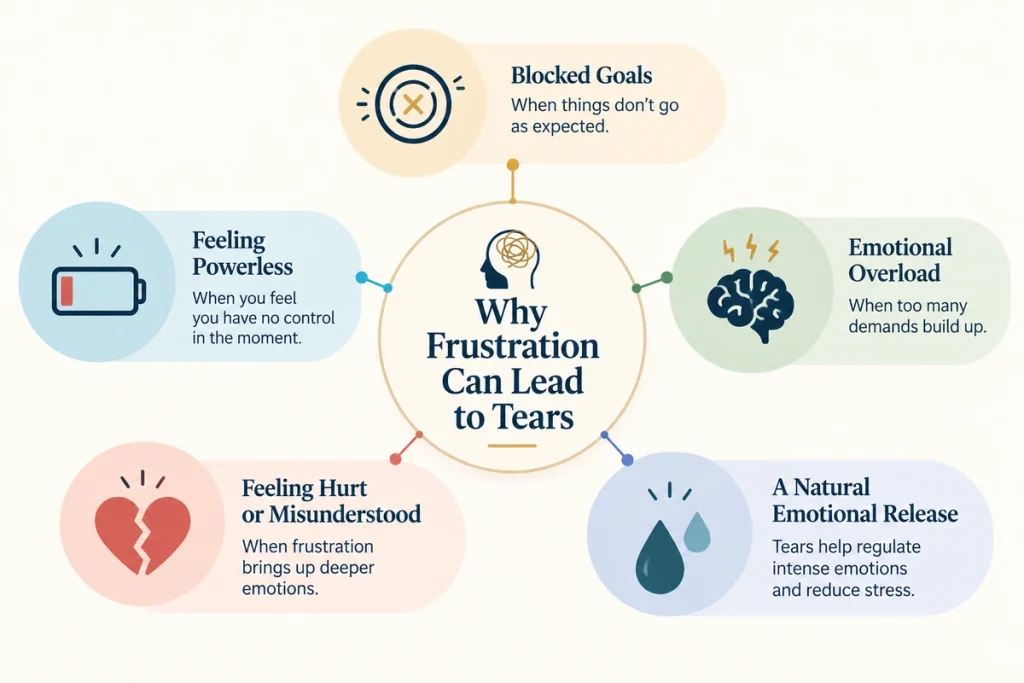
Frustration often arises when something blocks a goal, disrupts an expectation, or prevents us from doing what matters to us. Crying, meanwhile, can accompany several emotional experiences, including helplessness, overload, loneliness, and intense emotional distress.
A 2022 study by Barthelmäs and colleagues, published in Motivation and Emotion, examined common situations that lead to emotional crying. The researchers identified five categories: loneliness, powerlessness, overload, harmony, and media-related experiences. Their findings suggest that crying can be connected to the frustration or satisfaction of important psychological needs, rather than sadness alone.
Read the original research on the five reasons for crying.
This helps explain why two people can face a similar frustrating situation but respond differently. One might become quiet, another might express anger, and someone else might cry. Their responses can depend on what the situation means to them and what they are already experiencing.
Why Does Frustration Make Me Cry? Three Psychological Explanations
1. When frustration leaves you feeling powerless
Imagine that you have spent hours trying to resolve a problem, but nothing seems to work. You try another approach, explain yourself again, and make a genuine effort to improve the situation. Eventually, you feel so overwhelmed that tears begin to appear.
The tears may not be about the immediate problem alone. They may reflect the painful experience of trying hard while feeling unable to change the outcome.
Psychologists describe perceived control as the extent to which we believe our actions can influence what happens. When our efforts repeatedly seem ineffective, a situation can become more distressing. The 2022 study on emotional crying identifies powerlessness as one context in which tears may occur.
This does not mean every episode of crying reflects a loss of control. It offers one possible explanation for why a frustrating situation can become emotionally intense.
2. When emotional demands exceed your available resources
Sometimes, a small problem becomes the final demand in a day that has already required too much of you.
You may have responsibilities to manage, expectations to meet, and decisions to make. Even when you continue functioning, the effort involved can leave you with little capacity for another setback.
The same research identified overload as a common context for crying, particularly when people experience a mismatch between situational demands and their perceived ability to cope.
Consider a person who has spent the day managing deadlines and family responsibilities. When one more thing goes wrong, they suddenly feel unable to cope. The immediate problem may be minor, but the accumulated demands are not.
Rather than asking yourself, “Why am I making such a big deal out of this?”, consider asking, “How much have I already been trying to manage today?”
3. When frustration carries a deeper feeling of hurt
Not all frustration comes from tasks or practical obstacles. Sometimes, it develops in relationships.
You might feel frustrated when someone repeatedly misunderstands you, dismisses your concerns, or fails to acknowledge something important to you. You try to explain yourself, but the conversation seems to go nowhere.
At that point, frustration may coexist with hurt, disappointment, or a sense of being alone in the situation. Tears may accompany these feelings because the situation touches something emotionally important: the need to feel understood, respected, or connected.
Research on emotional crying also identifies loneliness and unmet needs for connection as common contexts for tears. However, we should not assume that every difficult conversation reflects rejection or that crying reveals a hidden psychological problem.
The useful question is not simply, “Why am I crying?” It is also, “What feels so difficult about this situation for me?”
Why Do I Get Frustrated So Easily When Small Things Go Wrong?
Have you noticed that something you could easily handle yesterday feels unbearable today? A minor mistake, a delayed response, or a task that refuses to work out may suddenly leave you close to tears.
One reason is that the emotional impact of an obstacle depends not only on what happened but also on what you were trying to achieve and how the setback affected you. Research on frustration suggests that people can differ in how they experience obstacles and blocked goals.
Consider three questions the next time a small problem feels unexpectedly difficult:
- What was I already dealing with? You may have less capacity for another demand after a difficult day.
- What did this setback mean to me? A mistake might feel especially painful if you were hoping to prove yourself or avoid disappointing someone.
- What feels outside my control? Repeatedly trying to change an outcome without success can make frustration harder to tolerate.
These questions are not a test, and there is no need to analyse every emotion. They simply help you distinguish the immediate trigger from the wider circumstances that may have made it harder to handle.
Sometimes the problem really is small. But the effort, disappointment, or uncertainty surrounding it may not be.
How to Handle Frustration Without Fighting Your Feelings
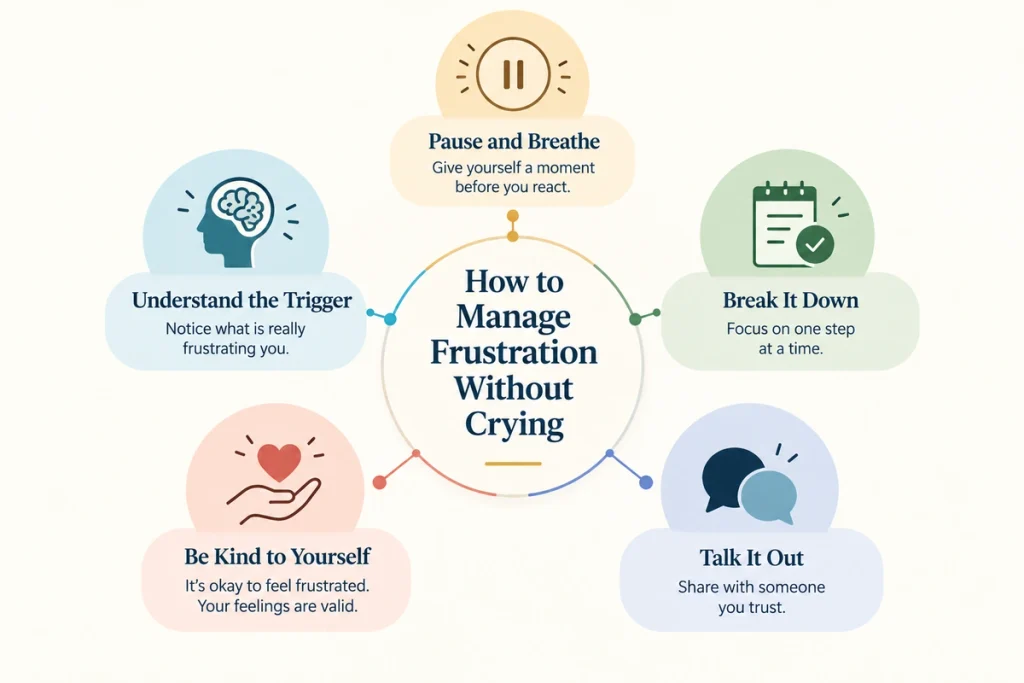
When frustration builds until you feel like crying, your first instinct may be to hide your tears, force yourself to calm down, or criticise yourself for reacting so strongly. A more helpful approach is to acknowledge what you are experiencing, give yourself time to respond, and decide what would actually help.
Give yourself time before responding
If you feel tears rising during a frustrating conversation or task, pause if you can. Relax your shoulders, breathe comfortably, and allow yourself a moment before deciding what to say or do.
You do not need to make the feeling disappear immediately. The aim is to avoid making an already difficult situation harder through an impulsive response.
If you need a break, it is reasonable to say, “I want to discuss this properly, but I need a few minutes first.”
Name the need beneath the emotion
Instead of asking, “Why am I so emotional?”, try asking, “What is making this situation difficult for me?”
Perhaps you need someone to listen without interrupting. Perhaps you need help with a task, more time to finish something, or clarity about an uncertain situation.
Naming the need can turn a vague sense of frustration into something you can address. It also helps you distinguish between a problem that needs practical action and an emotion that needs time and understanding.
Choose one practical next step
Once you have a clearer sense of what is happening, ask yourself what would help most right now.
- If the problem is solvable, identify one manageable action.
- If you feel misunderstood, explain what you need using calm, specific language.
- If the situation is outside your control, acknowledge the disappointment without demanding that you immediately feel better.
- If you are overwhelmed, consider whether you can postpone a non-urgent task or ask someone for support.
Research reviews suggest that emotion-regulation strategies differ in their effectiveness, and their usefulness depends on the person and situation. Learning to reconsider a situation, rather than simply trying to suppress the feeling, may be helpful.
For more practical guidance, read our article on emotional regulation as a life skill.
You can feel frustrated and still choose a thoughtful response. You can cry and still handle a difficult situation with maturity. The goal is not to stop yourself from feeling, but to understand your feelings well enough to decide what comes next.
When Should You Seek Support?
Feeling frustrated and crying occasionally is a normal human experience. You do not need to treat every emotional reaction as a problem that requires fixing.
However, consider seeking professional support if these episodes happen frequently, feel increasingly difficult to manage, or begin affecting your relationships, work, sleep, or everyday activities. Persistent changes in mood or the ability to cope may have different psychological, situational, or physical contributors.
A qualified mental health professional can help you explore what is happening, recognise patterns, and develop coping strategies suited to your circumstances. You do not have to wait until things become unbearable to ask for help.
In India, you can also contact the government’s Tele-MANAS mental health helpline by calling 14416 for round-the-clock support.
Frequently Asked Questions
Why do I cry when I am frustrated but not sad?
Frustration can coexist with helplessness, disappointment, overload, or feeling misunderstood. Crying is not exclusive to sadness, and tears do not necessarily mean you are unable to manage your emotions.
Is crying when frustrated a sign of weakness?
No. Crying is a human emotional response, not a measure of strength or maturity. What matters more is understanding your experience and finding constructive ways to respond to the situation.
How can I stop crying when I feel frustrated?
Rather than forcing yourself not to cry, try pausing, breathing comfortably, and identifying what is making the situation difficult. If possible, take a short break before continuing the conversation or task. If these episodes are persistent or interfere with daily life, consider seeking professional support.
Final Thoughts: You Can Feel Frustrated Without Blaming Yourself
Frustration that ends in tears can be confusing, especially when you cannot explain why a situation affected you so deeply. But your tears do not automatically mean you are weak, immature, or unable to manage your emotions.
Sometimes, frustration reflects a blocked goal. Sometimes, it accompanies feeling overwhelmed, powerless, or misunderstood. Understanding which experience you are having can help you respond with greater clarity and compassion.
The aim is not to eliminate every uncomfortable emotion. It is to recognise what you are experiencing, understand what you need, and choose your next step without judging yourself for being human.
References and Further Reading
- Barthelmäs, M., Kesberg, R., Hermann, A., & Keller, J. (2022). Five reasons to cry—FRC: A taxonomy for common antecedents of emotional crying. Motivation and Emotion, 46, 404–427. Read the original study.
- Barthelmäs, M., Stöckle, D., & Keller, J. (2024). On the social signal function of emotional crying: Broadening the perspective to social interactions in daily life. Emotion, 24(4), 960–974. Read the study on emotional crying.
- Webb, T. L., Miles, E., & Sheeran, P. (2012). Dealing with feeling: A meta-analysis of the effectiveness of strategies derived from the process model of emotion regulation. Psychological Bulletin, 138(4), 775–808. Read the research review.