

“Overthinking is one of the most exhausting experiences the human mind can create, not because life is happening around you, but because your mind refuses to let it go.”
It’s 2:17 AM…
The room is dark.
Your phone screen is the only thing lighting up the silence.
You promised yourself you would sleep early tonight.
Tomorrow is important.
And you have work to do, people to meet, and responsibilities waiting for you.
Your body is tired.
Your eyes are heavy.
But your mind…
Your mind has quietly decided that tonight is the perfect time to replay everything.
A conversation from this afternoon.
That email you sent.
The expression on your friend’s face before they left.
Something your boss said that might have meant nothing—or everything.
A mistake you made three years ago suddenly feels fresh again.
You imagine tomorrow’s meeting.
Then the next month.
Then the next five years.
Somewhere between midnight and morning, you’ve lived through twenty different futures.
None of them happened.
Yet your heart is beating as though they already did.
You tell yourself,
“Stop thinking.”
But the harder you try…
The louder your thoughts become.
So you keep negotiating with your own mind.
“Just one more thought.”
“Maybe if I understand this properly, I’ll finally feel calm.”
Except calm never arrives.
Only another thought.
And then another. Until the night quietly disappears.
Table of Contents
Here’s the strange part
Tomorrow, someone might look at you and say,
“You look fine.”
They’ll never know you’ve already fought a battle before sunrise.
Not with another person.
Not with your circumstances.
But with your own mind.
If you’ve ever experienced a night like this…
This article isn’t here to judge you.
It’s here to sit beside you.
Because what you’re experiencing isn’t simply “thinking too much”. It’s something much more human.
The Secret Nobody Told You About Overthinking
Most articles begin by defining overthinking.
Let’s not do that.
Instead, let’s begin with a question.
Why would a healthy human brain willingly exhaust itself?
Why would it replay conversations that cannot be changed?
Imagine disasters that may never happen?
Question every decision?
Analyze every possibility?
If the brain is designed to help us survive…
Why would it create so much suffering?
The answer surprised me the first time I truly understood it.
Your brain is not trying to torture you.
It’s trying to protect you.
Just not in the way you think.
The Smoke Alarm Mind
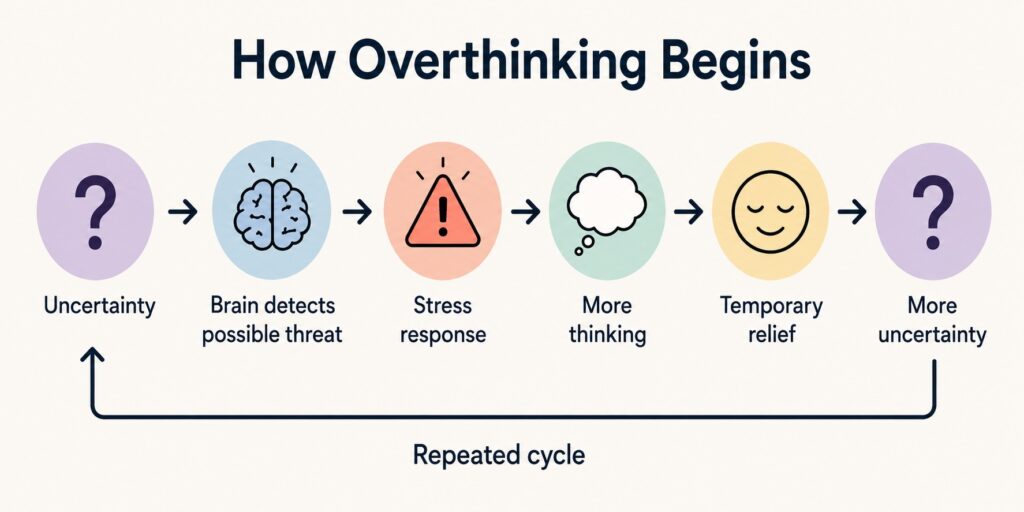
Imagine installing the world’s most sensitive smoke alarm in your home.
It doesn’t only react to fire.
It reacts to burnt toast.
Steam from a hot shower.
A scented candle.
Even a little cooking smoke.
Would you say the alarm is broken?
Not exactly.
It’s doing the job it was designed to do.
It’s detecting possible danger.
The problem is that it can no longer tell the difference between real danger and false alarms.
Our minds can behave in a remarkably similar way.
Sometimes, after repeated experiences of criticism, rejection, uncertainty, loss, or emotional pain, the brain becomes extra alert.
Not because it wants to make life difficult.
Because it wants to make life safe.
It begins scanning for threats everywhere.
A delayed reply becomes a warning.
A small mistake becomes a catastrophe.
An uncertain future becomes an emergency.
The mind rings the alarm.
Again.
And again.
And again.
The problem isn’t that the alarm exists.
The problem is that it never gets told.
“You’re safe now.”
The Mirror
Think about the last thing you’ve been overthinking.
Now ask yourself one gentle question.
Was I responding to what actually happened…
…or to what my mind feared might happen?
There is no right answer.
Only awareness.
And awareness is where emotional fitness begins.
Overthinking Is Not the Problem
This might sound surprising.
Overthinking itself is rarely the real problem.
It is the symptom.
Imagine seeing smoke rising from a building.
Would you blame the smoke?
Of course not.
You would ask,
“Where is the fire?”
Thoughts are often the smoke.
The real fire usually lives somewhere much deeper.
Fear.
Shame.
Loneliness.
Uncertainty.
Grief.
The need to be accepted.
The fear of being rejected.
The pressure to be perfect.
These emotions rarely announce themselves directly.
Instead, they quietly borrow the voice of thought.
Your mind starts analysing.
Planning.
Predicting.
Preparing.
Not because it enjoys worrying.
Because it believes thinking will protect you from feeling.
And that changes everything.
Because once you realise that overthinking is often an attempt to avoid emotional pain, your relationship with your thoughts begins to shift.
Instead of asking,
“How do I stop thinking?”
You begin asking,
“What is my mind trying so hard to protect me from?”
That single question has changed the lives of many people—not because it eliminates difficult thoughts overnight, but because it redirects attention to the place where real healing begins.
Why We Mistake Thinking for Control
Have you noticed something curious?
When life feels uncertain, the mind often becomes busier.
Waiting for medical test results.
A child returning home late.
An important interview.
A difficult conversation.
A financial decision.
The more uncertain the situation, the harder the mind works.
It feels productive.
It feels responsible.
Sometimes it even feels intelligent.
But there is an uncomfortable truth hiding beneath that activity.
Thinking and control are not the same thing.
Many of us were never taught how to sit with uncertainty.
So we learned something else.
We learned to think, to analyze, to prepare, to predict.
To mentally rehearse every possible outcome.
Not because it changes reality…
but because it creates the comforting illusion that we are doing something.
The mind whispers,
“If I think about it long enough, I’ll finally feel safe.”
Yet hours later, the uncertainty is still there.
Only now are we exhausted too.
The Emotional Weight Nobody Can See
One of the hardest parts about overthinking is that it leaves no visible scars.
People notice a broken arm.
They notice a fever.
They notice tears.
But they rarely notice the person who has spent six hours fighting invisible conversations inside their own head.
The employee who keeps smiling during meetings while secretly questioning every sentence they spoke.
The parent who worries whether one small mistake will affect their child’s future forever.
The student who studies for weeks but still believes they are going to fail.
The partner who reads the same text message ten times, searching for a meaning that may not even exist.
These people don’t look unwell.
They often look responsible.
Thoughtful.
Conscientious.
Reliable.
And many of them are.
Which is why overthinking is so easy to hide.
The world applauds the person who appears prepared.
It rarely sees the emotional cost of living in a constant state of mental preparation.
A Gentle Thought Before We Continue
If you’ve recognised yourself anywhere in these pages, I want you to pause for just a moment.
Not to fix yourself.
Not to judge yourself.
Simply to notice.
Perhaps your mind isn’t working against you.
Perhaps it has been working overtime for years, trying to keep you safe in the only way it knows.
That doesn’t mean it has chosen the healthiest strategy.
But it does mean you deserve compassion before criticism.
Because you cannot heal a mind by declaring war on it.
You heal it by helping it feel safe enough to rest.
And that is where our journey really begins.
Why Your Mind Keeps Returning to the Same Thoughts
The brain isn’t trying to ruin your peace. It’s trying to protect it—even when it chooses the wrong strategy.
There is a question that quietly follows almost every person who struggles with overthinking.
“If I know these thoughts aren’t helping me… why do they keep coming back?”
It’s a deeply frustrating experience.
You recognize that replaying the same conversation won’t change what happened.
And you know imagining every worst-case scenario won’t prevent it from occurring; you even tell yourself to stop.
And yet, a few minutes later, you’re back inside the same mental loop.
It can feel as though your mind has developed a life of its own.
But here’s the comforting truth:
Your brain isn’t working against you.
It is doing exactly what it evolved to do. The problem is that it cannot always tell the difference between a real danger and an emotional one.
Your Brain Was Designed to Keep You Alive—Not Comfortable
Imagine walking alone through a forest thousands of years ago.
A sudden rustle in the bushes could mean a wild animal.
Your ancestors didn’t survive because they ignored possible danger.
They survived because their brains reacted quickly—even if they were occasionally wrong.
That ancient survival system still exists inside us today.
The difference is that most modern threats are no longer physical.
Instead of predators, we face uncertainty.
A difficult conversation.
An unanswered message.
The possibility of rejection.
A financial setback.
A career decision.
The fear of disappointing someone we love.
To your thinking mind, these are emotional challenges.
To your survival system, they can feel like threats.
And when the brain senses a threat, it prepares you to deal with it.
The trouble is that it often chooses the same strategy:
Think more. Analyse more. Stay alert. Don’t let your guard down.
The Mirror
Think about the last time you couldn’t stop worrying.
Was there actual danger in that moment?
Or was your mind trying to prepare you for a danger that hadn’t happened yet?
Sometimes, our bodies react to possibilities as though they were certainties.
Recognising that difference is one of the first steps toward emotional freedom.
Meet the Amygdala: Your Brain’s Smoke Alarm
Deep inside the brain is a small structure called the amygdala.
You don’t need to remember its name.
You only need to understand its job.
Imagine a smoke alarm in your home.
It doesn’t ask whether the fire is large or small.
Its purpose is simple:
Detect possible danger. Sound the alarm.
Your amygdala works in much the same way.
When it senses something that resembles a threat—whether physical or emotional—it reacts quickly.
Sometimes that’s exactly what you need.
If a car suddenly swerves toward you, there’s no time for careful analysis.
Your brain acts first.
But emotional life is different.
A delayed reply from a friend isn’t a speeding car.
Constructive feedback isn’t physical danger.
Making a mistake in a presentation isn’t a life-threatening event.
Yet if your brain has learned, through past experiences, that criticism, rejection, or uncertainty feels deeply painful, the amygdala may respond as though those experiences are emergencies.
The alarm rings.
Your heart races, your thoughts speed up, and your attention narrows.
And before you realise it, you’re mentally searching for every possible explanation.
Not because you’re irrational.
Because your brain is trying to protect you.
Why Thinking Feels Like Safety
Here’s one of the most surprising psychological truths about overthinking.
Thinking creates the feeling of doing something.
When we face uncertainty, action often isn’t immediately possible.
You can’t force someone to reply to your message.
You can’t instantly know whether you’ll get the job.
And you can’t even guarantee that everyone will understand your intentions.
But you can think, you can replay, you can predict, and you can rehearse.
The mind mistakes this mental activity for progress.
It whispers,
“Keep thinking. You’re getting closer to the answer.”
Except many questions in life don’t have perfect answers.
And many worries cannot be solved in advance.
So the mind keeps working long after useful thinking has ended.
What began as problem-solving quietly becomes rumination.
The rocking chair moves tirelessly.
But it never leaves the room.
When Your Brain Confuses Certainty with Safety
One of the deepest human needs is the need to feel safe.
Not only physically.
Emotionally.
We want to know that our relationships are secure.
That our decisions are right.
That our future will be okay.
The difficulty is that life never offers complete certainty.
So the overthinking mind tries to create it.
It reviews every possibility.
Every conversation, every decision, and every mistake.
It hopes that if it thinks hard enough, uncertainty will finally disappear.
But certainty is not something the human mind can manufacture.
The more desperately we chase it, the more anxious we often become.
That is why many overthinkers don’t actually need more answers.
They need a greater capacity to live with unanswered questions.
And that capacity is at the heart of emotional fitness.
The Quiet Role of Cortisol
When your brain believes you’re under threat, it signals your body to release stress hormones, including cortisol.
In the short term, cortisol is helpful.
It gives you energy and prepares you to respond.
But when your mind stays caught in an endless cycle of imagined threats, your body may remain on alert longer than it needs to.
You might notice it in subtle ways:
You wake up tired, even after a full night’s sleep.
Your shoulders stay tense without realising it.
You find it difficult to relax on weekends.
Small decisions feel strangely exhausting.
Your body has been preparing for battles that never arrived. No wonder it feels tired.
What This Means for You
If you’ve been blaming yourself for not being able to “just stop overthinking”, I hope this section offers a different perspective.
Your mind isn’t weak.
It is not trying to make your life miserable; it has simply learned that constant vigilance feels safer than uncertainty.
The good news is that what the brain learns, it can also relearn.
Not overnight.
Not through force.
But through repeated experiences of emotional safety, self-awareness, and healthier ways of responding to uncertainty.
And that is exactly where we’ll go next.
Because understanding why you overthink is important.
Learning how overthinking quietly shapes your personality, relationships, and everyday decisions is where the transformation begins.
The Hidden Faces of Overthinking
“Overthinking doesn’t wear the same face every day. Sometimes it looks like responsibility. Sometimes it looks like perfectionism. And even sometimes it even looks like love. But beneath every face lies the same quiet hope—to feel safe in an uncertain world.”
Why Overthinking Looks Different in Different People
If you ask ten people whether they overthink, you’ll probably hear ten different stories.
One person can’t stop replaying conversations.
Another spends weeks worrying before making a decision.
Someone else constantly imagines worst-case scenarios.
A parent lies awake wondering whether they’re raising their child the “right” way.
A young professional keeps rewriting an email because it still doesn’t feel perfect.
Different situations.
Different people.
Yet the same psychological process.
Overthinking is like water. It takes the shape of whatever container it is poured into.
To understand your own patterns, it helps to recognise the different faces your mind wears when it’s trying to protect you.
1. The Perfectionist
“If I can make everything perfect, nothing can go wrong.”
The perfectionistperfectionistThe Perfectionist isn’t chasing excellence.
They’re chasing emotional safety.
That distinction changes everything.
Excellence says,
“I’ll do my best.”
Perfectionism whispers,
“If I make one mistake, people will think less of me.”
Imagine spending thirty minutes writing an email that should have taken five.
Not because the email is difficult.
Because every sentence feels like a reflection of your worth.
You reread.
Edit.
Delete.
Rewrite.
By the time you press “Send”, you’re already worrying whether it sounded too formal… or not formal enough.
The world sees someone who is detail-orientated. Only you know how exhausting it feels.
The Hidden Psychology
Many perfectionists didn’t grow up believing mistakes were opportunities to learn.
They grew up believing mistakes were evidence that they weren’t good enough.
Over time, the mind quietly reached a conclusion:
“If I can eliminate mistakes, maybe I can avoid rejection.”
The problem is that perfection isn’t a destination.
It’s a moving target.
No matter how well you perform, the mind simply raises the standard.
The Mirror
When was the last time you celebrated something you did well…
without immediately thinking about what could have been better? Sometimes perfection steals joy long before it steals success.
2. The Approval Seeker
“What if they misunderstood me?”
This face of overthinking often hides behind kindness.
You replay conversations, you wonder if your message sounded rude, and you apologise even when you haven’t done anything wrong.
You feel responsible for keeping everyone happy, and you fear disappointing people.
Not because you enjoy pleasing others.
Because being accepted feels emotionally safe.
Everyday Example
A friend replies with a simple,
“Okay.”
For many people, that’s the end of the conversation.
For the approval seeker, it’s the beginning of a hundred imaginary ones.
“Are they upset?”
“Did I say something wrong?”
“Should I send another message?”
Hours of emotional energy can disappear into trying to solve a problem that may never have existed.
3. The Future Predictor
“I just want to be prepared.”
This is perhaps the most convincing form of overthinking because it often disguises itself as responsibility.
Planning is healthy.
Preparing is wise.
But constantly imagining disaster is something different.
The Future Predictor mentally rehearses every possible outcome.
The flight might be delayed.
The interview might go badly.
The investment might fail.
The medical report might reveal the worst.
The irony is painful.
The future they’re trying so hard to protect themselves from begins stealing today’s peace.
The Hidden Psychology
The brain believes,
“If I imagine every possible danger, I won’t be caught by surprise.”
Unfortunately, life doesn’t become more predictable.
It simply becomes harder to enjoy.
4. The Regret Collector
“Why did I say that?”
Some people collect memories.
Others collect regrets.
The Regret Collector revisits moments that everyone else has forgotten.
An awkward joke.
A presentation from years ago.
A conversation that could have gone differently.
The mind treats old memories like unfinished business.
It keeps reopening the same file, hoping that one more review will somehow change the ending.
It never does.
The Emotional Cost
Every visit to the past quietly steals attention from the present. The mind becomes a museum of old mistakes instead of a place where new experiences can grow.
Pause for a Moment
Ask yourself gently:
If I met someone who made the same mistake I did five years ago, would I judge them as harshly as I judge myself?
If the answer is no…
Perhaps your standards for yourself have become heavier than your compassion.
5. The Silent Caregiver
“Everyone else comes first.”
This face of overthinking is common among parents, caregivers, teachers, healthcare workers, and deeply empathetic people.
They constantly think about other people’s needs.
Whether everyone is okay, whether someone might be hurt.
Outwardly, this looks like love.
And often, it is.
But when caring becomes constant mental responsibility, it slowly transforms into emotional exhaustion.
The Silent Caregiver rarely asks,
“How am I doing?” Their mind is too busy carrying everyone else.
6. The Control Builder
“If I can plan everything, I’ll be okay.”
Some people make endless lists.
Others repeatedly check, organise, or prepare.
Planning itself isn’t unhealthy.
But when planning becomes an attempt to remove every uncertainty, the mind quietly becomes trapped.
The difficult truth is that control has limits.
You can prepare for a meeting, but you cannot control how everyone in the room will respond.
You can love someone deeply, but you cannot control every decision they make.
And the most important thing is that you can save money, but you cannot control every unexpected turn life may take.
Learning this isn’t pessimistic.
It’s freeing.
Because peace grows when we stop confusing preparation with control.
7. The Inner Critic
“You should have known better.”
Of all the hidden faces of overthinking, this one speaks the loudest.
It comments on everything.
Every mistake becomes proof that you’re inadequate; every success is dismissed as luck, and every compliment is questioned.
The Inner Critic believes harshness creates improvement.
Research and lived experience suggest something different.
People often grow more consistently when they feel safe enough to learn—not when they constantly fear failure.
Self-compassion doesn’t lower standards.
It creates the emotional stability needed to meet them.
Why You May See Yourself in More Than One Face
Perhaps you recognised yourself in several of these patterns.
That’s normal.
Human beings are wonderfully complex.
The same person can become a future predictor before an important interview, an approval seeker in a close relationship, and a regret collector when lying awake at night.
The labels aren’t meant to box you in.
They’re meant to help you notice.
Because of what we notice, we can begin to understand.
And what we understand, we can begin to change.
What This Means for You
Overthinking isn’t a single habit.
It’s a collection of emotional strategies your mind has developed over the years.
Some were learned in childhood, some through painful experiences, and some through love, responsibility, or the desire to protect yourself.
None of these faces make you weak.
They make you human.
But they also remind us of something important:
You don’t overcome overthinking by fighting your mind.
You overcome it by gently teaching your mind that it no longer has to carry every burden alone.
That is the quiet work of emotional fitness.
The Quiet Price of Living Inside Your Mind
“The greatest cost of overthinking isn’t that it fills your mind with noise. It’s that it slowly steals your ability to fully experience your own life.”
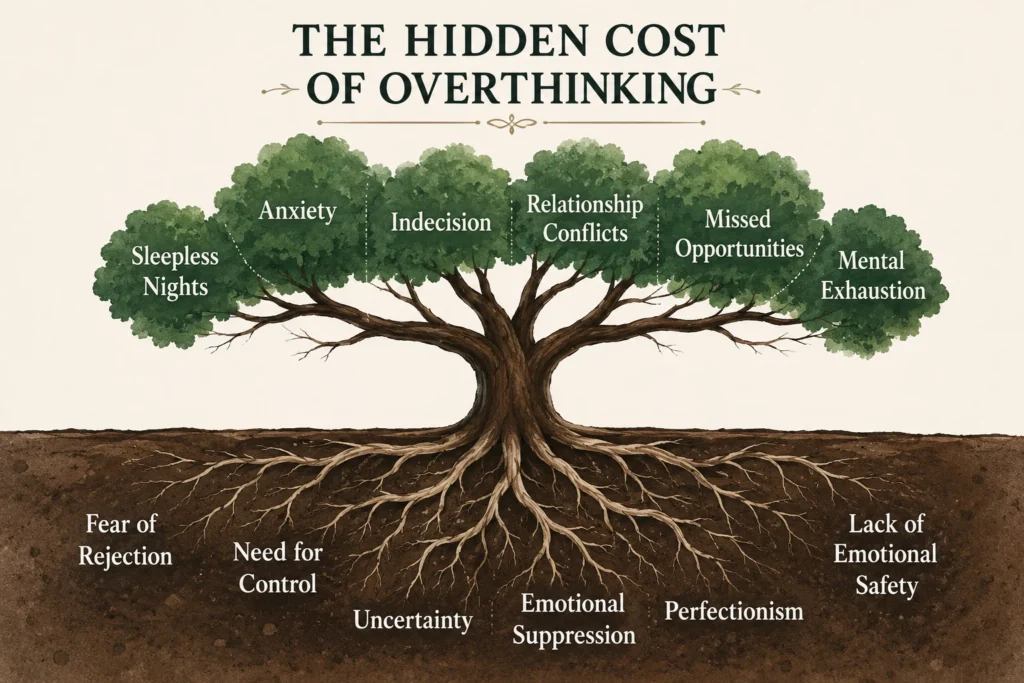
Life Doesn’t Usually Break All at Once
One of the biggest misconceptions about psychological struggles is that they arrive dramatically.
Most don’t.
They arrive quietly.
One postponed decision.
One sleepless night.
One conversation you never had.
One opportunity you convinced yourself you weren’t ready for.
Then another.
And another.
Months later, you realise you aren’t just tired.
You’re living more inside your thoughts than inside your life.
Overthinking rarely changes who you are overnight.
It changes the direction of your life through hundreds of tiny moments that seem insignificant on their own.
The Opportunities That Never Even Began
Many people imagine failure as trying something and not succeeding.
Psychology suggests another kind of failure—one that’s much harder to see.
The opportunities we never pursued.
The ideas we never shared.
The business we never started.
The promotion we never applied for.
The relationship we never explored.
Not because we lacked ability.
But because our minds kept asking for one more guarantee before taking the first step.
“What if I fail?”
“What if I’m not good enough?”
“Maybe next year, when I’m more prepared.”
The painful irony is this:
Overthinkers often delay action until they feel confident.
But confidence usually grows after taking action, not before it.
By waiting for certainty, they unknowingly postpone the very experiences that would have built it.
Pause for a Moment
Think of one opportunity you’ve postponed.
Now ask yourself gently:
Was I waiting for the right time… or was I waiting to stop feeling uncertain?
Sometimes those are not the same thing.
When Relationships Become Stories Instead of Experiences
Relationships don’t exist only in conversations.
They also exist in the stories we tell ourselves about those conversations.
Imagine this.
Your partner comes home from work unusually quiet.
They say very little during dinner.
An emotionally regulated mind might think,
“Perhaps they had a difficult day.”
An overthinking mind often begins writing an entirely different story.
“Did I do something wrong?”
“Are they upset with me?”
“Are they losing interest?”
“Should I ask? Or would that make things worse?”
Notice what happened.
The relationship quietly shifted from reality to imagination.
Before any facts were known, fear filled the empty spaces with its own explanations.
Psychologists sometimes refer to this as negative interpretation bias—our tendency, especially when anxious, to interpret ambiguous situations in the most threatening way.
The story feels real.
The emotions become real.
Yet the story itself may be entirely inaccurate.
How many arguments begin not because of what happened… but because of what we imagined had happened?
When Love Becomes Hypervigilance
This pattern is especially common among people who love deeply.
Parents.
Partners.
Caregivers.
Adult children looking after aging parents.
Their love is genuine.
But somewhere along the way, love quietly merges with constant vigilance.
“Did my child reach safely?”
“What if my parents aren’t telling me they’re unwell?”
“Why hasn’t my spouse called yet?”
Care becomes continuous monitoring.
Concern becomes chronic tension.
The mind begins believing that worrying is a measure of love.
But worrying and caring are not the same thing.
Love grows through presence.
Worry often grows through imagined danger.
One nourishes relationships.
The other quietly exhausts the person who cares.
The Creativity We Sacrifice
There is another cost of overthinking that rarely receives attention.
Creativity.
Think about the moments when you’ve had your best ideas.
Perhaps while taking a walk.
Listening to music.
Showering.
Travelling.
Relaxing with a cup of tea.
Rarely do people say,
“My most creative idea came while I was panicking.”
Creativity requires mental space.
Overthinking fills that space.
A mind constantly scanning for danger has very little room left for curiosity, imagination, or innovation. This is why many artists, writers, entrepreneurs, and professionals describe their greatest breakthroughs arriving not when they forced themselves to think harder but when they finally allowed themselves to breathe.
Decision Fatigue: When Even Small Choices Feel Heavy
Have you ever stood in front of a menu for ten minutes because you couldn’t decide what to order?
Or spent an hour comparing products online, only to close the browser without buying anything?
This isn’t always about the decision itself.
It’s about the emotional weight attached to making the “wrong” one.
Psychologists sometimes call this analysis paralysis.
The more options we consider, the more mentally exhausted we become.
Eventually, making no decision feels safer than making an imperfect one.
Ironically, avoiding decisions is still a decision.
It simply allows circumstances to choose for us.
The Body Keeps Listening
One of the most remarkable things about the human body is that it listens to the mind.
Not because thoughts magically create illness.
But because prolonged stress influences many systems throughout the body.
When your mind spends hours preparing for imagined dangers, your body cannot always tell the difference between an imagined threat and a real one.
You may notice:
- Tight shoulders that never seem to relax.
- Frequent headaches.
- Restless sleep.
- Jaw clenching.
- Digestive discomfort during stressful periods.
- Feeling mentally exhausted despite doing very little physical work.
These experiences can have many possible causes, and they don’t automatically mean overthinking is responsible.
But they remind us that emotional life and physical well-being are closely connected.
Your body hears every conversation your mind keeps having.
The Indian Story: Why So Many of Us Learn to Overthink
Our thoughts do not develop in isolation.
They are shaped by families, schools, workplaces, and cultures.
For many people growing up in India, achievement is deeply valued.
Parents often make enormous sacrifices for their children’s education.
Teachers encourage high standards.
Society celebrates success.
These values have helped countless people strive, persevere, and achieve remarkable things.
But they can also have an unintended consequence.
Some children quietly begin to believe:
“If I perform well, I will be appreciated.”
“If I disappoint others, I may disappoint the people I love.”
As adults, this can sometimes evolve into constant self-monitoring.
“Did I do enough?”
“What will people think?”
“I can’t afford to make mistakes.”
This isn’t uniquely Indian, and it certainly doesn’t apply to every family.
But for many readers, these experiences may feel familiar.
Recognising them isn’t about blaming our upbringing.
It’s about understanding how our environment can shape the habits of our minds. And once we understand those habits, we gain the freedom to reshape them.
The Mirror
Think back to your childhood.
What happened when you made a mistake?
Were you encouraged to learn from it…
or mainly encouraged not to repeat it?
Our answers to that question often echo much longer than we realise.
Success Without Peace
Perhaps the saddest consequence of chronic overthinking is that it can quietly disconnect achievement from enjoyment.
You finally receive the promotion.
Instead of celebrating, you worry about whether you’ll meet expectations.
You buy your dream home.
Now you worry about maintaining it.
Your child performs well.
You immediately begin worrying about the next examination.
Every destination becomes another starting line.
Nothing feels enough for long.
Not because life lacks blessings.
Because the mind has forgotten how to rest in them.
Success can improve our circumstances.
But unless we also develop emotional fitness, it cannot guarantee inner peace.
What This Means for You
If you’ve seen pieces of your own life in this chapter, please don’t read it as a verdict.
Read it as an invitation.
Not to fear your mind.
But to understand it.
Overthinking is rarely the voice of weakness.
More often, it is the voice of a mind that has spent years believing it must stay alert to keep you safe.
The cost is real.
But so is the possibility of change.
Because the remarkable thing about the human brain is this:
The patterns it learns can be reshaped.
Not through harsh self-criticism.
But through awareness, practice, and the gradual development of emotional fitness.
And that is where our journey now turns—not toward fighting the mind, but toward training it with compassion.
Emotional Fitness – The Skill That Changes Your Relationship With Your Mind
“You don’t become emotionally fit when life becomes easier. You become emotionally fit when you learn to meet life’s uncertainties without losing yourself.”
What If the Goal Was Never to Stop Thinking?
If you’ve read this far, you may have noticed something.
At no point have I told you to “stop overthinking”.
That is intentional.
Because the human mind was never designed to stop thinking.
It was designed to think, to imagine, to remember, to plan, and to protect.
The goal, therefore, isn’t to silence your thoughts.
The goal is to stop letting every thought become a command.
There is a profound difference between the following:
Having a thought…
and
Believing every thought deserves your attention.
Emotionally fit people still experience uncertainty.
They still make mistakes.
They still worry about people they love.
The difference is that they don’t automatically follow every anxious thought wherever it leads.
They’ve learnt a skill that many of us were never taught:
How to feel an emotion without immediately trying to escape it.
The Emotional Fitness Framework
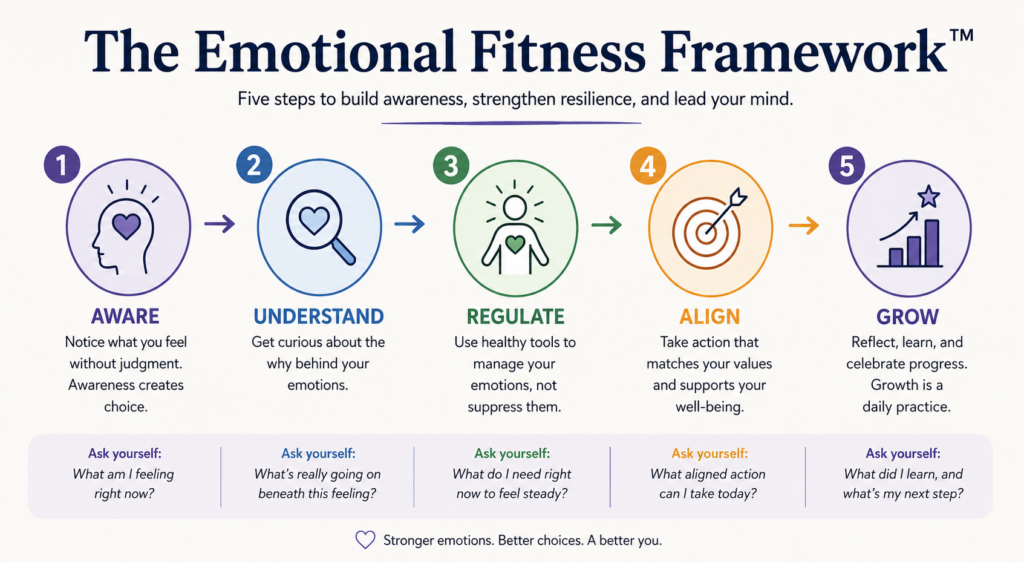
Over the years, I’ve come to see emotional fitness not as the absence of difficult emotions, but as the ability to respond to them wisely.
Think of it as strengthening an emotional muscle rather than searching for emotional perfection.
For readers of this blog, I’d like to introduce a simple framework that can be practised in everyday life.
The Five Steps of Emotional Fitness
1. Notice
Before changing a thought, notice it.
Instead of saying,
“I’m an anxious person.”
Try saying,
“I’m noticing that my mind is becoming anxious.”
That small change creates psychological distance.
You are no longer your thoughts.
You are the observer of your thoughts.
Awareness is the first step toward freedom.
2. Name
Our brains often calm down when we accurately identify what we’re feeling.
Ask yourself:
“What am I actually feeling right now?”
Is it fear?
Embarrassment?
Loneliness?
Uncertainty?
Disappointment?
Many people discover they weren’t overthinking at all.
They were avoiding an emotion they hadn’t yet named.
3. Normalise
Being anxious before an interview doesn’t mean something is wrong with you.
Feeling uncertain before making a big decision doesn’t mean you’re weak.
Missing someone doesn’t mean you’re dependent.
Being human includes emotional discomfort.
Normalisation removes unnecessary shame.
4. Navigate
Now ask:
“What does this situation actually need from me?”
Not every thought requires another hour of analysis.
Sometimes it requires the following:
One conversation.
One decision.
One apology.
One boundary.
Or simply one good night’s sleep. Emotional fitness is knowing the difference.
5. Nurture
Speak to yourself as you would speak to someone you deeply love.
Research increasingly suggests that self-compassion supports resilience, emotional regulation, and healthier coping—not because it lowers standards, but because it reduces the fear that often keeps people stuck.
Kindness is not the opposite of growth.
It is often what makes growth sustainable.
The 7-Day Emotional Fitness Challenge
Lasting change doesn’t happen through reading alone.
It happens through practice.
Here’s a gentle challenge to begin training your emotional fitness.
Day 1 – Catch One Thought
Notice one repetitive worry.
Don’t fight it.
Just observe it.
Day 2 – Name the Emotion
Ask:
“What emotion is hiding beneath this thought?”
Day 3 – Limit the Replay
When you catch yourself mentally replaying a conversation, gently ask:
“Is there anything new I’m learning, or am I simply reliving it?”
Day 4 – Choose One Small Action
Instead of solving everything, solve one thing.
Action often quiets the mind more effectively than endless analysis.
Day 5 – Practice Self-Compassion
Notice how you speak to yourself after making a mistake.
Would you use the same words with someone you care about?
If not, try choosing different words for yourself.
Day 6 – Welcome Uncertainty
Deliberately leave one small question unanswered. Notice that discomfort is temporary—and survivable.
Day 7 – Celebrate Progress, Not Perfection
Ask yourself:
“Am I responding differently than I did last week?”
Growth is rarely dramatic.
It is usually quiet.
Pause for a Moment
Close your eyes for a few seconds.
Take one slow breath.
Now finish this sentence honestly:
“The thought I’ve been carrying for too long is…”
You don’t have to solve it today.
Sometimes healing begins the moment we stop pretending we aren’t carrying it.
A Gentle Conversation With Yourself
If your mind has been noisy lately…
Perhaps it isn’t asking you to think harder; it’s asking you to feel something you’ve been postponing.
Perhaps it is asking for rest.
For reassurance, for compassion, for permission to not have every answer.
You have spent years trying to protect yourself.
That deserves respect.
But protection doesn’t always require constant vigilance.
Sometimes it requires trust.
Trust that mistakes do not define your worth.
Trust that difficult emotions eventually move through us when we allow ourselves to experience them instead of endlessly analyzing them.
From the Author’s Heart
If you’ve recognized yourself anywhere in this article, I want you to remember one thing.
You are not exhausting yourself because you are weak.
You are exhausting yourself because your mind has been trying, in the only way it knows, to keep you safe.
That strategy may have helped you once.
But you don’t have to carry it forever.
Emotional fitness isn’t about winning a battle against your thoughts.
It’s about building a friendship with your mind.
A friendship based not on fear…
but on understanding.
Not on perfection…
but on presence.
Not on certainty…
but on courage.
And perhaps that is the quiet freedom you’ve been searching for all along.
Frequently Asked Questions (FAQs)
Can overthinking be stopped completely?
Not entirely—and it doesn’t need to be. The goal is to develop a healthier relationship with your thoughts rather than eliminating them.
Is overthinking a mental illness?
No. Overthinking itself isn’t a mental illness, but it can occur alongside anxiety, depression, obsessive-compulsive disorder (OCD), and other conditions. If it causes significant distress or interferes with daily life, consulting a qualified mental health professional is recommended.
Why do intelligent people overthink?
Intelligence doesn’t automatically cause overthinking. Factors such as personality, life experiences, perfectionism, uncertainty, and coping styles often play a bigger role.
What is the difference between thinking and overthinking?
Thinking helps you solve problems and move forward. Overthinking keeps you stuck in repetitive mental loops without bringing meaningful progress.
Final Thoughts
Overthinking is often described as a thinking problem.
I no longer believe that.
I believe it is, more often, a relationship problem.
Not a relationship with other people.
But a relationship with uncertainty.
A relationship with emotions.
A relationship with yourself.
When that relationship changes, your thoughts gradually begin to change too.
Because overthinking isn’t the inability to stop thinking.
It’s often the inability to feel safe enough to stop.
And emotional fitness is the lifelong practice of helping your mind discover that safety again.
A Gentle Note
This article is intended for educational purposes and is not a substitute for professional mental health care. If persistent overthinking is causing significant distress or interfering with your daily life, consider speaking with a qualified mental health professional.
Great content! Keep up the good work!