
It didn’t happen overnight. It starts slow, where you begin to lose your emotional fitness.
Not with an emotional breakdown.
Not with something that changes your life.
And even without a diagnosis.
Just little moments.
A smile that covered disappointment.
A polite “I’m okay” when the truth was far more complicated.
A habit of swallowing frustration because speaking up felt uncomfortable.
A belief—picked up somewhere along the way—that showing emotion made a person weak.
Perhaps you’ve experienced moments like these.
You walk into your workplace carrying worries from home yet greet everyone with your usual smile. You comfort a friend through their difficult week while quietly ignoring your own. Even when you reassure your family that everything is under control, even though your mind feels anything but calm.
From the outside, life appears normal.
Inside, however, something feels increasingly heavy.
The strange part is that nothing seems obviously wrong.
You continue meeting deadlines, laugh at jokes, pay the bills, and keep showing up.
Yet by the end of the day, you’re exhausted—not because your body has worked too hard, but because your mind has been carrying emotions it never had the chance to put down.
Many people assume this is simply what adulthood feels like.
Psychology suggests something different.
It suggests that the exhaustion we often attribute to busy lives may also come from something far less visible:
the effort of constantly managing emotions without truly processing them.
For decades, society admired people who appeared emotionally unshakeable.
We praised those who “kept it together”.
Who never cried, stayed silent during conflict, and carried pain without letting anyone notice.
Somewhere along the way, emotional silence became confused with emotional strength.
But modern psychology is telling a different story.
Researchers studying resilience, emotional regulation, stress, and mental well-being have found that long-term psychological health is rarely built by ignoring emotions. Instead, it grows from learning how to understand them, work with them, and recover from them.
This is where a new idea has begun attracting attention—not only among psychologists but also among educators, healthcare professionals, workplace leaders, and people simply trying to navigate everyday life.
That idea is emotional fitness.
Table of Contents
What Is Emotional Fitness?
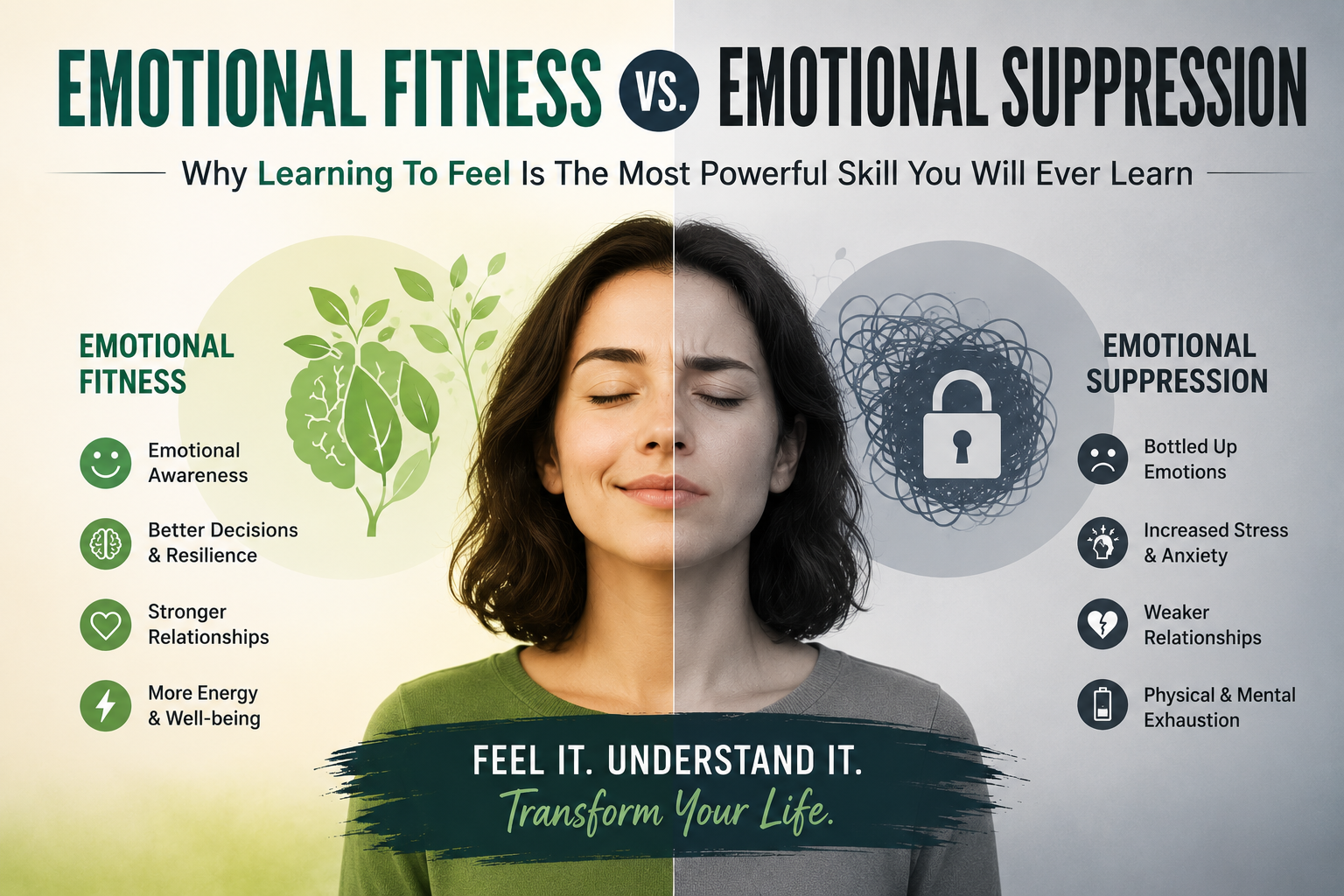
Unlike emotional suppression, emotional fitness doesn’t ask us to become less emotional.
It teaches us to become more emotionally skilled.
The difference may seem subtle.
In reality, it changes almost everything.
Because emotions are not problems waiting to be eliminated.
They are signals waiting to be understood.
Imagine driving a car across a long highway.
Suddenly, a warning light appears on the dashboard.
You have two choices.
The first is to cover the warning light with a piece of tape so you no longer have to look at it.
The second is to pull over, understand what the light is trying to tell you, and respond before a small issue becomes a major breakdown.
Most of us would never ignore our car’s warning system.
Yet many of us spend years doing exactly that with our emotions.
We distract ourselves, we stay endlessly busy, and we scroll through our phones.
We convince ourselves we’ll deal with our feelings “later”.
Sometimes, later never comes.
The emotions don’t disappear.
They simply wait.
And often, they return in unexpected ways—through irritability, sleepless nights, chronic stress, emotional numbness, or a lingering sense that something isn’t quite right.
Emotional fitness begins with a simple but transformative shift in perspective:
Instead of asking,
“How do I stop feeling this?”
We begin asking,
“What is this feeling trying to teach me?”
That single question changes our relationship with our emotional world.
It doesn’t make life easier overnight.
It doesn’t remove grief, disappointment, fear, or uncertainty.
But it helps us carry those experiences differently.
And sometimes, the way we carry our emotions matters more than the emotions themselves.
In this guide, we’ll explore why emotional fitness has become one of the most valuable psychological skills of our time.
We’ll discover what modern science tells us about emotions, why suppressing them often comes at a hidden cost, how the brain responds to emotional experiences, and—most importantly—how each of us can begin strengthening emotional fitness through simple, practical habits woven into everyday life.
Because emotional strength isn’t measured by how little you feel.
It’s measured by how wisely you learn to live with what you feel.
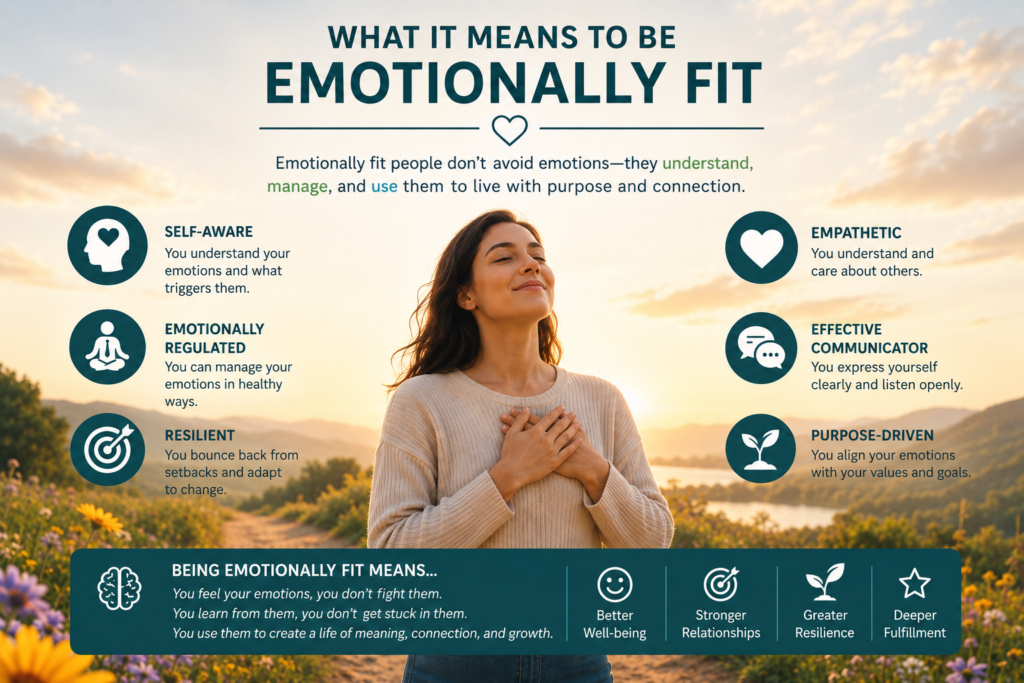
What does it mean to be emotionally fit?
Most people pause here.
Not because the idea is unfamiliar, but because very few of us were ever taught to think about emotional health in the same way we think about physical health.
Yet the comparison is surprisingly accurate.
Just as physical fitness doesn’t mean your body never gets tired, emotional fitness doesn’t mean you never feel anxious, angry, sad, frustrated, disappointed, or afraid.
Those emotions are part of being human.
Emotional fitness is something entirely different.
It is the ability to experience emotions without becoming overwhelmed by them, to understand what they are communicating, and to respond thoughtfully instead of reacting impulsively.
In other words, emotional fitness isn’t about controlling your emotions.
It’s about building a healthy relationship with them.
Think of someone who exercises regularly.
They don’t become strong after one visit to the gym.
Strength develops through repeated, often unremarkable choices—showing up, practising consistently, recovering well, and gradually adapting to greater challenges.
Emotional fitness develops in much the same way.
Every difficult conversation is handled with honesty.
Every stressful moment is met with awareness instead of panic.
These moments become repetitions for the emotional mind.
Slowly, almost invisibly, resilience grows.
And just like physical fitness, emotional fitness isn’t measured on your best day.
It’s revealed on your hardest ones.
Emotional Suppression: The Habit That Often Disguises Itself as Strength
Imagine holding a beach ball underwater.
At first, it doesn’t seem particularly difficult. You press down with both hands, and it stays beneath the surface.
But after a while, your arms begin to tire. The pressure builds. The harder you push, the more force the ball gathers beneath the water. And the moment you lose your grip, it bursts back to the surface with surprising intensity.
Our emotions often behave in much the same way.
When psychologists talk about emotional suppression, they aren’t referring to the occasional decision to stay calm during an important meeting or to postpone tears until you’ve reached a private place. Those moments are part of healthy self-control.
Emotional suppression becomes a problem when it turns into a way of living.
It happens when we repeatedly tell ourselves the following:
“Don’t think about it.”
“Move on.”
“It’s not a big deal.”
“Other people have it worse.”
“Stop being so emotional.”
These phrases may sound practical. Sometimes they even sound wise.
But over time, they teach us an important lesson—one that isn’t actually true.
They teach us that emotions are problems to hide rather than experiences to understand.
And once that lesson becomes deeply rooted, many people stop recognising what they feel altogether.
They don’t say,
“I’m hurt.”
Instead they say,
“I’m just tired.”
They don’t notice disappointment.
Only irritation.
They don’t recognise loneliness.
Only boredom.
Gradually, emotional awareness fades.
It’s a little like living in a house where the smoke alarm has been disconnected. At first, the silence feels peaceful. But silence isn’t always safety. Sometimes it’s simply the absence of an important warning signal.
We Rarely Learn Emotional Suppression on Our Own
No child is born believing that sadness should be hidden.
Children cry openly.
Laugh loudly.
Express frustration honestly.
Their emotional world is direct and uncomplicated.
So what changes?
Most of us slowly learn emotional suppression from the environments around us.
Perhaps a little boy hears,
“Boys don’t cry.”
A little girl is praised for always being “the good child” who never causes trouble.
A teenager learns that vulnerability becomes gossip.
An employee discovers that expressing stress is interpreted as weakness.
A parent feels guilty for admitting exhaustion.
Without anyone intentionally teaching it, a powerful message begins to emerge:
Certain emotions are acceptable. Others should remain invisible.
By adulthood, many people have become experts at performing emotional stability while privately struggling with emotional overload.
The performance is so convincing that even they begin believing it.
Until one day, something unexpectedly small breaks the pattern.
A forgotten email.
A minor disagreement.
A delayed train.
A simple question from a loved one.
Suddenly the reaction feels much bigger than the situation itself.
People often describe these moments by saying,
“I don’t know why I reacted like that.”
Psychology offers a possible explanation.
Sometimes we aren’t reacting only to today’s event.
We’re reacting to yesterday’s unprocessed emotions as well.
The Cost of Carrying an Invisible Backpack
Imagine carrying a backpack.
Every difficult emotion becomes one small stone.
One disappointment.
One argument left unresolved.
One fear never spoken aloud.
One grief postponed.
One apology never received.
One expectation you quietly buried.
None of these stones feels especially heavy on its own.
So you keep walking.
Days become months.
Months become years.
Eventually the backpack becomes part of your identity.
You forget what it feels like to walk without it.
This is one of the hidden costs of emotional suppression.
The burden becomes so familiar that we mistake it for normal life.
Psychologists sometimes describe this as allostatic load—the cumulative wear and tear on the body and mind that results from repeated stress responses over time.
Your emotional experiences don’t simply disappear because you stop talking about them.
Your nervous system continues keeping score.
Why Suppressed Emotions Don’t Simply Vanish
One of the most fascinating discoveries in neuroscience is that emotions involve the entire body—not just the mind.
When something emotionally important happens, several systems begin working together almost instantly.
Your brain evaluates the situation.
Your nervous system prepares for action.
Stress hormones may increase.
Your heart rate changes, breathing shifts, and muscles become more alert.
This entire process happens long before you consciously decide how to respond.
The emotional response itself isn’t the problem.
It’s your relationship with that response that determines whether the experience becomes manageable or overwhelming.
Many people imagine emotions like unwanted visitors.
Psychology suggests something closer to this:
Emotions are messengers.
Some bring good news.
Some bring difficult news.
But every messenger arrives carrying information.
Ignoring the messenger doesn’t change the message.
The Brain’s Emotional Team
Rather than thinking of the brain as one powerful machine, imagine it as a team of specialists working together.
The Amygdala
Think of the amygdala as your internal security guard.
Its job is simple:
“Is this safe?”
It constantly scans your environment for possible threats—not only physical danger but also social rejection, embarrassment, uncertainty, and emotional pain.
Sometimes it reacts faster than conscious thought.
That speed once helped humans survive.
Today it sometimes causes us to worry before we’ve had a chance to think clearly.
The Prefrontal Cortex
If the amygdala is the security guard, the prefrontal cortex is the thoughtful adviser.
It asks questions like
“Is this actually dangerous?”
“What’s the best response?”
“Will this matter next week?”
“Should I pause before reacting?”
Emotional fitness strengthens this partnership.
Instead of allowing either system to dominate, emotionally healthy people gradually become better at helping these brain regions work together.
The Hippocampus
The hippocampus acts like the brain’s librarian.
It stores memories and provides context.
That’s why a familiar smell, a song, or even a particular sentence can suddenly trigger emotions from years ago.
Sometimes our emotional reactions make perfect sense—not because of today’s situation, but because today’s situation resembles something our brain remembers from the past.
Understanding this helps us become less self-critical.
Instead of saying,
“Why am I overreacting?”
We begin asking,
“What memory or experience might my brain be connecting this to?” That small shift often opens the door to healing.
Emotional Fitness Is Not Emotional Control
This is where many people become confused.
They imagine emotionally healthy individuals never becoming angry, never crying, never feeling anxious, and never doubting themselves.
Reality looks very different.
Emotionally fit people experience the same emotional spectrum as everyone else.
The difference lies in what happens next.
Instead of immediately reacting…
They become curious.
Instead of suppressing…
They explore.
Instead of judging themselves…
They listen.
Emotional fitness isn’t about controlling every emotion.
It is about responding intentionally after the emotion arrives.
That distinction changes everything.
Psychology of Emotional Fitness in Everyday Life
Consider two friends, Maya and Aisha, who both receive disappointing news: neither has been selected for a job they deeply wanted.
Maya immediately tells herself,
“Forget it. There’s no point thinking about it.”
She throws herself into work, avoids discussing her feelings, and insists she’s already moved on.
For the next few weeks, however, she finds herself unusually impatient. She snaps at small inconveniences, struggles to sleep, and quietly questions her self-worth, even though she rarely admits it.
Aisha’s first reaction is also painful.
She feels disappointed and embarrassed.
But instead of pushing those emotions away, she takes time to understand them. She writes in her journal, talks with a trusted friend, allows herself to grieve the missed opportunity, and then begins reflecting on what she learned from the experience.
Neither woman avoided emotional pain.
The disappointment existed for both.
The difference was in what happened after the feeling appeared.
Maya tried to escape the emotion.
Aisha chose to process it.
Weeks later, one is still carrying the weight of an unspoken loss.
The other has begun making room for hope again.
That is emotional fitness in everyday life.
Not the absence of difficult emotions, but the ability to move through them rather than becoming trapped beneath them.
Research Spotlight
Over the past three decades, psychologists studying emotion regulation have repeatedly observed an important pattern.
People who habitually rely on emotional suppression often report higher levels of stress, lower relationship satisfaction, and greater emotional exhaustion than those who use healthier strategies such as emotional awareness, cognitive reappraisal, and acceptance.
One reason appears to be that suppression changes outward behaviour more than inner experience.
In other words, a person may look calm on the outside while their body continues responding internally as though the emotional challenge is still active.
This helps explain why “keeping everything inside” can feel so draining.
Calm behaviour and a calm nervous system are not always the same thing.
Learning emotional fitness means working with both.
Emotional Fitness vs Emotional Suppression: The Clear Difference
At this point, one important question naturally arises.
If emotional suppression feels so automatic and even socially rewarded at times… then what exactly makes emotional fitness different in real life?
The answer becomes clearer when we place both side by side—not as abstract ideas but as lived experiences.
Emotional Fitness vs Emotional Suppression
| Aspect | Emotional Fitness | Emotional Suppression |
| Relationship with emotions | Emotions are signals to understand | Emotions are problems to hide |
| Internal experience | Awareness + acceptance | Disconnection or denial |
| Response style | Pause → reflect → choose response | React or shut down |
| Stress processing | Processed and released gradually | Stored and accumulated |
| Long-term effect | Resilience and clarity | Emotional fatigue and confusion |
| Self-talk | “What am I feeling and why?” | “I shouldn’t feel this.” |
| Body response | Calmer nervous system over time | Chronic tension and stress load |
| Relationships | Open communication | Emotional distance or misunderstanding |
The key difference is not whether emotions exist.
Both individuals feel everything.
The difference is what they do next.
Why Emotional Suppression Feels “Easier” in the Moment
One of the reasons emotional suppression is so common is because it often works short-term.
If you ignore anger, you can continue working.
If you ignore anxiety, you can finish a task.
The brain interprets this as “success”.
But this success comes with a hidden trade-off.
What is not processed is not removed—it is postponed.
And postponed emotions tend to return later with greater intensity, often at moments when we least expect them.
This is why people sometimes describe emotional overload as
“I don’t know why I suddenly broke down.”
In reality, the breakdown is rarely sudden.
It is cumulative.
What Happens When Emotions Are Repeatedly Suppressed
When emotional experiences are consistently pushed aside, the body does not simply reset.
Instead, several subtle changes begin to occur over time:
The Nervous System Stays “Activated”
Even when a situation is over, the body may continue behaving as if it is still happening.
This can show up as:
- Restlessness
- Irritability
- Sleep disturbance
Difficulty relaxing
Emotional Awareness Becomes Blunted
People often stop identifying emotions clearly.
Instead of saying
- “I feel sad.”
They might say:
- “I feel empty.”
- “I feel tired all the time.”
This is emotional confusion, not emotional absence.
Small Problems Start Feeling Big
When emotional processing is delayed, even minor stressors can feel overwhelming because the system is already overloaded.
Relationships Become Harder
Unexpressed emotions rarely disappear in isolation.
They often show up indirectly:
- Withdrawal
- Irritability
- Miscommunication
- Emotional distance
People around you sense something is wrong but cannot identify what.
Emotional Fitness in Real Life
Let’s make this practical.
Imagine two people in the same situation:
Situation:
A colleague ignores your message at work.
Person A (Suppression Pattern)
- “It’s fine; I shouldn’t care.”
- Moves on quickly.
- But later feels irritated without knowing why.
- Overthinks unrelated things at night.
- Builds silent resentment over time.
Person B (Emotional Fitness Pattern)
- Notices feeling slighted or ignored.
- Mentally acknowledges: “I feel dismissed.”
- Asks: “Is there a pattern or just a one-time event?”
- Chooses response: maybe clarify or let it go consciously.
- Emotion resolves instead of accumulating.
Same event. Different processing.
This is emotional fitness in action—not dramatic, not complicated, just aware.
The 7 Core Habits of Emotional Fitness
Emotional fitness is not a personality trait.
It is a set of repeatable mental habits.
Here are the most important ones.
Naming the Emotion (Not Just Feeling It)
Most people stay at:
- “I feel bad.”
Emotionally fit individuals move toward the following:
- “I feel disappointed and slightly anxious.”
Naming reduces emotional intensity because the brain begins organising experience instead of reacting blindly.
Separating Facts from Interpretations
Example:
- Fact: “They didn’t reply to my message.”
- Interpretation: “They are ignoring me.”
Emotional fitness asks, “What do I know, and what am I assuming?”
Allowing Emotion Without Immediate Reaction
This is not suppression.
This is a pause.
A simple internal sentence: “I am feeling this right now, and I don’t need to act immediately.”
Understanding Emotional Triggers
Instead of asking:
“Why am I like this?”
Ask:
“What does this remind me of?”
This connects present emotions with past experiences.
Expressing Emotion in Safe Forms
Not all expression is verbal.
Healthy outlets include:
- Journaling
- Talking to someone safe
- Walking
- Creative expression
- Reflection
Expression is release, not escalation.
Self-Validation Before External Validation
Instead of waiting for someone else to say
“You’re right to feel this.”
You learn to say:
“My feelings make sense given my experience.”
Returning to Baseline Calm
After emotional experiences, emotionally fit people consciously reset:
- Breathing
- Rest
- Routine
- Physical grounding
This tells the nervous system, “The situation is over now.”
The 10-Minute Emotional Fitness Routine
You don’t need hours of meditation or therapy sessions to begin building emotional fitness.
You need consistency.
Try this simple daily routine:
Step 1: Pause (1 minute)
Sit quietly and ask:
“What am I feeling right now?”
Step 2: Name (2 minutes)
Write or think:
- Emotion(s)
- Intensity (0–10)
Step 3: Understand (3 minutes)
Ask:
- “What triggered this?”
- “What story am I telling myself?”
Step 4: Reframe (2 minutes)
Ask:
- “Is there another explanation?”
Step 5: Release (2 minutes)
Do one:
- Deep breathing
- Short walk
- Write one paragraph
- Talk to someone
This is not about fixing emotions.
It is about moving them through your system instead of storing them.
Myth vs Reality
❌Myth:
Strong people don’t feel overwhelmed.
✔Reality:
Strong people learn how to move through overwhelm without getting stuck in it.
❌Myth:
If I ignore emotions, they go away.
✔Reality:
Ignored emotions often return later in different forms.
❌Myth:
Emotional control means staying calm all the time.
✔Reality:
Emotional fitness means recovering faster after emotional disruption.
When Holding Back Emotions Is Helpful (And When It’s Not)
Emotional suppression is often portrayed as entirely harmful.
But psychology paints a more balanced picture.
There are situations where temporarily setting emotions aside is not only helpful but necessary.
For example:
- A doctor performing emergency surgery
- A firefighter entering a burning building
- A student writing an exam despite personal stress
- A parent handling a child’s immediate crisis
In these moments, emotional suppression acts like a temporary shield, allowing action to continue when immediate focus is required.
The key word here is temporary.
Healthy emotional functioning is not about expressing everything instantly.
It’s about delaying emotional processing where needed and returning to it when it’s safe to do so.
The problem begins when delay becomes avoidance.
When “I’ll deal with it later” becomes “I never deal with it.”
That is where emotional fitness becomes essential.
The Integration Point: Emotional Fitness in Life
Emotional fitness is not a method.
It is a relation.
A relationship with your inner world.
It looks something like this:
- Feeling without drowning
- Understanding without overanalysing
- Expressing without exploding
- Pausing without suppressing
- Reflecting without self-judgement
It is not about achieving emotional perfection.
It is about reducing internal conflict.
Because most emotional suffering does not come from emotions themselves.
It comes from fighting them.
Frequently Asked Questions (FAQs)
1. What is emotional fitness in psychology?
Emotional fitness refers to the ability to recognise, understand, regulate, and recover from emotional experiences in a healthy and adaptive way. It focuses on emotional awareness and resilience rather than emotional avoidance.
2. Is emotional suppression always bad?
No. Emotional suppression can be useful in short-term situations that require immediate action or control. However, long-term suppression without emotional processing can increase stress and reduce psychological well-being.
3. How is emotional fitness different from emotional intelligence?
Emotional intelligence focuses on recognising and understanding emotions in yourself and others. Emotional fitness goes further by emphasising how well you manage emotional experiences over time, especially under stress.
4. Can emotional fitness reduce anxiety?
Yes. Research in emotion regulation suggests that people who develop healthier emotional awareness and processing skills tend to experience lower chronic anxiety and better stress management.
5. How long does it take to build emotional fitness?
There is no fixed timeline. Emotional fitness develops gradually through daily awareness, reflection, and practice. Even small consistent habits can create meaningful change over time.
Final Psychological Insight
There is a quiet strength in learning how to stay with yourself emotionally.
Not by resisting what you feel.
Not by escaping it.
But by learning to sit beside it with awareness.
Some emotions will be uncomfortable.
Some will not make immediate sense.
But none of them are meaningless.
And none of them are permanent.
Emotional fitness is not about becoming untouched by life.
It is about becoming steady enough within yourself that life no longer feels like something you must constantly survive.
It becomes something you can actually experience.
Fully.
Honestly.
And with a little more understanding than before.
And maybe that is what real emotional strength has always been.
Not silence.
Not control.
But the ability to stay present with your own mind—without abandoning it.
3 thoughts on “Emotional Fitness vs. Emotional Suppression: Why Learning To Feel Is The Most Powerful Skill You Will Ever Learn”